
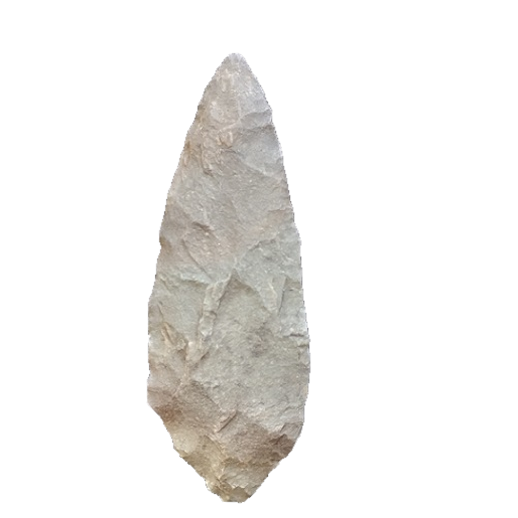
Arrowhead type
Boats Blade
Boats Blade4,000 - 3,500 B.P.Late Archaic2 reference photos
Key facts
- Age
- 4,000 - 3,500 B.P.
- Cultural period
- Late Archaic
- Size
- Large
- Shape
- Ovoid
- Glacial period
- Neoglacial
More from the Archaic period
Description
The point exhibits a expansive, ovoid silhouette, characterized by a cross-sectional profile that transitions from elliptical to flattened. Its blade displays an excurvate morphology, narrowing progressively towards the distal terminus while also converging towards the proximal base. The basal margin is defined by a sharp, pointed termination. The flaking pattern observed on this specimen is random, lacking a discernible, organized arrangement.
Size
Large
Distribution
These artifacts are mainly discovered in Massachusetts and throughout the adjacent area.
Additional information
According to the research conducted by Lavin in 2013, a compelling theory has emerged regarding the potential functions of certain archaeological artifacts. It is suggested that these particular finds may have served as preforms, which are unfinished or intermediate stages in the production of broader-bladed point types. Alternatively, they could have been utilized as scrapers or knives, highlighting the resourcefulness and adaptability of the cultures that created them. This dual possibility underscores the complexity and nuance of ancient toolmaking traditions, where a single artifact could have multiple intended uses or evolve over time to fulfill different purposes. By examining these artifacts through the lens of Lavin's research, we gain a deeper understanding of the technological and functional sophistication of prehistoric societies.
Identified by
- Named by
- Dena F. Dinvcauze
- Year
- 1968
- Type site
- Bristol County, Massachusetts
Similar types
Types that are easy to confuse with the Boats Blade point.
- Atlantic Phase Blade
- Mansion Inn / Watertown Variant
- Web Blade