
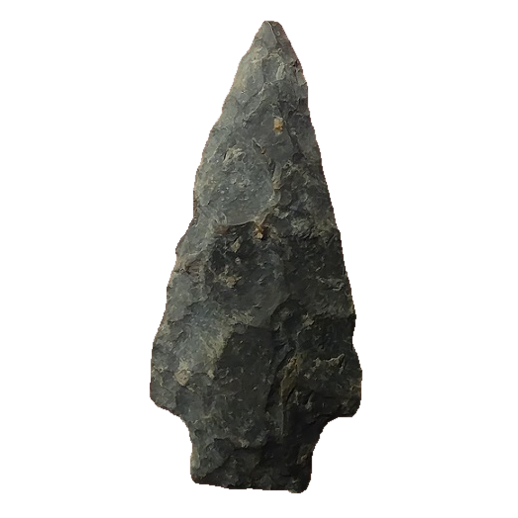
Arrowhead type
Atlantic Phase Blade
Atlantic Phase Blade4,150 - 3,650 B.P.Late Archaic2 reference photos
Key facts
- Age
- 4,150 - 3,650 B.P.
- Cultural period
- Late Archaic
- Culture
- Atlantic Phase Culture
- Size
- Medium to Large
- Shape
- Contracting Stem
- Glacial period
- Neoglacial
More from the Archaic period
Description
This triangular point exhibits a stemmed to contracting stemmed morphology, characterized by a medium to large size and an elliptical cross-sectional profile. The blade's curvature is variable, ranging from excurvate to straight, with some specimens displaying a pronounced flare at the shoulder region. The shoulders themselves are distinctive and can be oriented horizontally or at a slight upward inclination. The stem is notably short and tapers slightly, terminating in a base that is typically straight but may occasionally be convex. The flaking pattern observed on this point is random, lacking a discernible or systematic arrangement.
Size
The dimensions of the arrowheads are as follows: they range in length from 40 to 110 mm, with stem lengths varying between 9 and 19 mm, and blade widths spanning from 25 to 50 mm.
Distribution
This type is predominantly discovered in the seaside areas of Massachusetts and the adjacent territory.
Also found, less often, in
Additional information
The archaeological record reveals a distinct type of arrowhead that is predominantly linked to the region of Massachusetts and its neighboring areas. Notably, a significant finding was published in the Journal of New York State Archaeological Society in 1996, which documented the presence of this arrowhead type at various sites in southern New York. This discovery underscores the type's geographic distribution and cultural significance. While this type has been referenced in numerous professional archaeological studies, it appears to have garnered more widespread recognition as a distinct category among collector communities, highlighting the importance of interdisciplinary dialogue and collaboration in the field of archaeology.
The acknowledgment of this arrowhead type as a distinct category is a testament to the ongoing efforts of archaeologists and collectors to classify and understand the diverse array of Native American projectile points. By examining the distribution and characteristics of this type, researchers can gain valuable insights into the cultural practices, trade networks, and technological developments of the indigenous populations that created these artifacts. Further study of this type can also inform our understanding of the regional cultural dynamics and the historical context in which these arrowheads were produced and used.
The presence of this arrowhead type in both Massachusetts and southern New York suggests a level of cultural exchange and interaction between the indigenous groups of these regions. As archaeologists continue to investigate the characteristics and distribution of this type, they may uncover additional information about the technological, social, and economic factors that influenced the development and use of these artifacts. By exploring the complexities of Native American material culture, researchers can work towards a more nuanced understanding of the rich and diverse cultural heritage of the region's indigenous populations.
Identified by
- Named by
- Dena Dincauze
- Year
- 1972
Similar types
Types that are easy to confuse with the Atlantic Phase Blade point.
- Koens Crispin
- Savannah River
- Schuylkill
- Snook Hill