
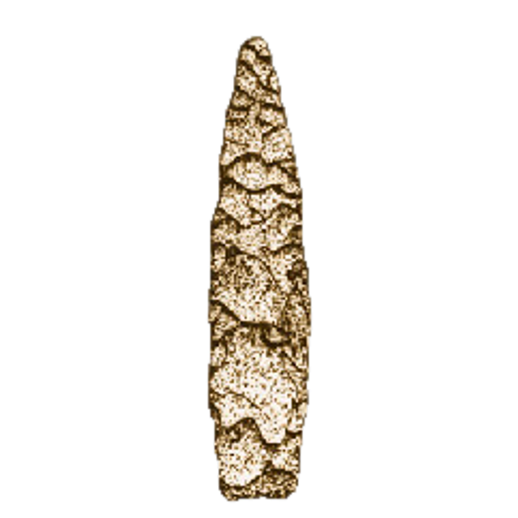
Arrowhead type
Birch Creek Point
Birch Creek9,000 - 7,000 B.P.Transitional Paleo to Early Archaic5 reference photos
Key facts
- Age
- 9,000 - 7,000 B.P.
- Cultural period
- Transitional Paleo to Early Archaic
- Size
- Medium
- Shape
- Lanceolate to Triangle to Ovoid
- Material
- Agate
- Glacial period
- Early to Middle Holocene
Description
This projectile point exhibits a slender, elongated form, transitioning from a medium ovoid to a lanceolate shape, with a cross-sectional profile that shifts from elliptical to plano-convex. The blade's curvature is characterized by an excurvate profile, where the distal end tapers inward, approaching a parallel alignment, while the proximal section curves inward, forming a distinctive basal contour. The basal morphology varies, ranging from a straight to subtly concave edge in one type, to a convex base with rounded corners in another. The flaking pattern observed on this point is random, lacking a discernible, organized sequence.
Size
The dimensions of the arrowheads are as follows: they range in overall length from 44 to 75 mm, with blade widths spanning 15 to 26 mm, and thicknesses varying between 5 and 8 mm.
Distribution
This type is mainly discovered in the middle to southeastern areas of Idaho, extending into the neighboring territories of Utah, Wyoming, and Montana. This type has also been located as far west as Long Valley, Idaho
Additional information
In the realm of Native American arrowhead studies, a particular type has garnered limited attention in academic literature, as observed by Granger and Ireland in 1986. The initial reference to this type can be attributed to Butler, who not only coined the term but also provided illustrations of specimens discovered near the mouth of the Portneuf River. However, Butler's work stopped short of providing a detailed description of the type. It was Swanson, King, and Chatters who subsequently built upon this foundation by naming and describing two distinct subcategories, designated as Type A and Type B. Notably, these researchers also alluded to a third variant, Type C, although they did not furnish a description or visual representation of this subtype. A comprehensive understanding of the geographic distribution of this arrowhead type remains elusive, as neither Swanson nor Butler provided an exhaustive account of its range.
The scarcity of information on this type underscores the need for further research to elucidate its characteristics, cultural associations, and spatial distribution. By examining the work of these pioneering researchers, we can gain insight into the complexities of Native American arrowhead typology and the importance of continued investigation into the nuances of these ancient artifacts. The fact that Type C was mentioned but not described suggests that there may be additional, unexplored aspects of this arrowhead type waiting to be uncovered.
The study of Native American arrowheads, including this rarely discussed type, offers a unique window into the lives and traditions of indigenous cultures. As archaeologists, it is essential to continue exploring and documenting these artifacts to deepen our understanding of the historical and cultural contexts in which they were created. By doing so, we can work towards a more comprehensive and nuanced appreciation of the rich cultural heritage of Native American communities, and the significant role that arrowheads have played in their history and traditions.
Identified by
- Year
- 1969
- Type site
- Birch Creek Valley, Idaho
Similar types
Types that are easy to confuse with the Birch Creek point.
- Agate Basin
- Cascade
- Embarras
- Haskett Type 1
- Humboldt
- Owl Cave