
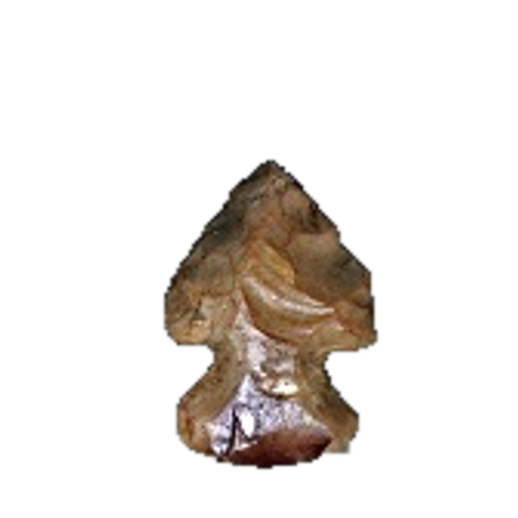
Arrowhead type
Bennington Point
Bennington1,500 - 1,000 B.P.Woodland2 reference photos
Key facts
- Age
- 1,500 - 1,000 B.P.
- Cultural period
- Woodland
- Culture
- Intrusive Mound Culture
- Size
- Small to Medium
- Shape
- Corner Notch to Side Notch
- Glacial period
- Roman Warm to Vandal Minimum
More from the Woodland period
Description
This corner notch point exhibits a compact to moderate size, characterized by a flattened elliptical profile. The blade edge can range from gently curved to straight, displaying a varied silhouette. Notably, the shoulders are adorned with barbs, transitioning into an expanding stem that can impart a subtly swollen appearance to the base, which is itself convex. The flaking pattern on this point is irregular and non-directional, lacking a discernible orientation.
Size
Small to Medium
Distribution
This type is mainly linked to the upper Ohio River Valley, notably southwestern Pennsylvania and extending into northwestern New York
Mainly found in
Additional information
In the realm of Native American archaeology, a notable discovery was made at the Wolf Creek Site in Pennsylvania, where a distinctive arrowhead point was unearthed. This finding was documented in the Pennsylvania Archaeologist, volumes 66-68, published in 1996. The characteristics of this point are further elucidated in the work of Stanley W. Lantz, who in 1989, authored a comprehensive study titled "Age, Distribution, and Cultural Affiliation of Raccoon Notched Point Varieties in Western Pennsylvania and Western New York." This seminal work, published as No. 20 of the New York Bulletin by the Carnegie Museum of Natural History in Pittsburgh, PA, provides invaluable insights into the cultural context and distribution of this particular type of arrowhead.
Lantz's research sheds light on the Raccoon Notched point, a type that holds significant interest for archaeologists studying the prehistory of Western Pennsylvania and Western New York. By examining the age, distribution, and cultural affiliation of these points, Lantz's study contributes to a deeper understanding of the technological and cultural developments of the Native American groups that inhabited this region. The discovery at the Wolf Creek Site, in conjunction with Lantz's work, underscores the importance of continued archaeological investigation into the lives and traditions of Native American communities, highlighting the complex and nuanced history of human presence in this area.
The Raccoon Notched point, as discussed by Lantz, represents a fascinating example of the diversity and richness of Native American material culture. Through the analysis of such artifacts, archaeologists can reconstruct aspects of the daily lives, technological advancements, and cultural exchange networks of these communities. The documentation of this point at the Wolf Creek Site, coupled with Lantz's in-depth study, serves as a testament to the value of interdisciplinary research and collaboration in advancing our knowledge of Native American archaeology, ultimately enriching our appreciation for the history and heritage of the region.
Identified by
- Named by
- James Herbstritt
Similar types
Types that are easy to confuse with the Bennington point.
- Intrusive Mound
- Raccoon Creek
- St. Charles