
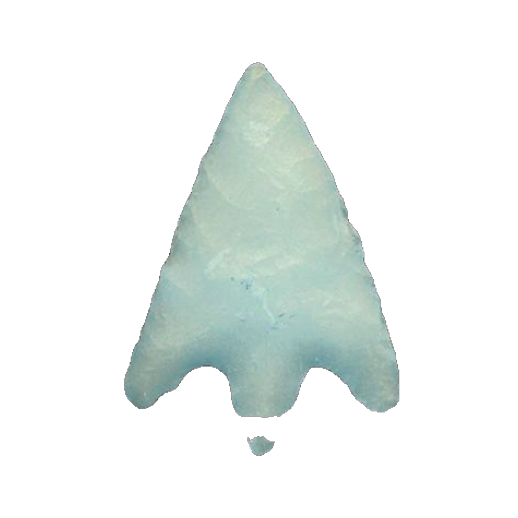
Arrowhead type
Bassett Pointed Stem Point
Bassett Pointed Stem600 - 300 B.P.Mississippian to Late Prehistoric9 reference photos
Key facts
- Age
- 600 - 300 B.P.
- Cultural period
- Mississippian to Late Prehistoric
- Culture
- Caddoan Culture
- Size
- Small
- Shape
- Contracting Stem to Basal Notch to Corner Notch
- Glacial period
- Little Ice Age
More from the Mississippian, Late Prehistoric periods
Description
This slender, triangular point exhibits a distinctive contracting stem and a flattened profile, typically measuring around 1 inch in length. The blade edge can range from gently excurvate to straight, often featuring fine serrations that impart a sharp, toothed appearance. Notably, the distal end is frequently flaked to a needle-like point, accentuating the point's piercing capability. The shoulders are characterized by prominent barbs that can extend downward, sometimes surpassing the base of the point. The stem itself is short and tapering, terminating in a pointed base. In specimens with particularly long shoulder barbs, the stem may appear as a small, central protrusion within a deeply concave base. Overall, the workmanship on these points is of high quality, with a random, non-patterned flaking technique evident on the surface.
Size
The dimensions of these arrowheads are characterized by a total length ranging from 17 to 42 mm, with the majority typically measuring less than 35 mm. The stem length varies between 1 and 5 mm, averaging approximately 3 mm. In terms of width, the measurements fall within the range of 12 to 18 mm, as documented by Suhm and Krieger (1954).
Distribution
This type is mainly discovered in the northeast region of Texas, the southwest area of Arkansas, the southeast section of Oklahoma, and the northwest part of Louisiana.
Additional information
According to Perino's 1985 observations, the distinctive small pointed stem found on certain arrowheads appears to have played a crucial role in the functional design of these projectiles. Specifically, this stem likely facilitated the secure positioning and stabilization of the point within the hollow cane shafts that were commonly used in the region. By providing a centralized anchor point, the small pointed stem would have helped to ensure a stable and balanced fit, allowing the arrowhead to be effectively seated and secured within the shaft. This clever design feature would have been essential for the effective use of these arrowheads in hunting and other activities, highlighting the ingenuity and craftsmanship of the Native American cultures that created them.
Identified by
- Named by
- Clarence H. Webb
- Year
- 1948
- Type site
- Multiple sites around Bassett, Bowie County, Tx
Similar types
Types that are easy to confuse with the Bassett Pointed Stem point.