
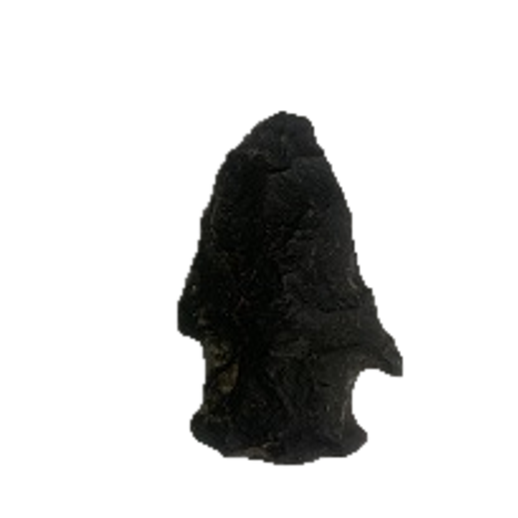
Arrowhead type
Armstrong Point
Armstrong2,400 - 1,600 B.P.Developmental to Late Prehistoric2 reference photos
Key facts
- Age
- 2,400 - 1,600 B.P.
- Cultural period
- Developmental to Late Prehistoric
- Culture
- Armstrong Culture
- Size
- Small to Medium
- Shape
- Corner Notch
- Glacial period
- Roman Warm
More from the Late Prehistoric, Developmental periods
Description
This artifact is characterized by a compact, short corner notch point configuration, exhibiting an elliptical profile in cross-section. The blade's curvature is predominantly excurvate, with the notches originating from the corners of the preform and creating barbed shoulders that delineate the blade's edges. The base of the point is expansive, varying in shape from a straight line to a gently convex curve. The flaking pattern observed on this specimen is random, lacking a discernible, organized sequence.
Size
Small to Medium
Distribution
This artifact is linked to the Armstrong Culture of West Virginia and is mainly discovered in the Gauley River basin.
Mainly found in
Also found, less often, in
Additional information
In his 1965 publication, Edward V. McMichael shed light on a distinct cultural entity, meticulously detailing the artifacts that define this ancient society. Notably, McMichael's research reveals that this culture underwent a significant transformation, eventually giving rise to the subsequent Buck Garden Culture. A key artifact linked to this cultural phase is a specific type of projectile point, which is intriguingly associated with the Armstrong ceramic tradition. This connection highlights the complex and dynamic nature of prehistoric cultural development, where the evolution of material culture reflects the shifting social, economic, and technological landscapes of ancient communities.
The association between this point and Armstrong ceramics underscores the importance of considering the broader cultural context in which artifacts were created and used. By examining the relationships between different artifact types, researchers can gain a more nuanced understanding of the social, symbolic, and functional roles that these objects played in the lives of their creators. In this case, the connection to Armstrong ceramics suggests that the point may have been an integral part of a larger cultural complex, one that encompassed not only hunting and subsistence practices but also ceremonial, social, and economic activities.
McMichael's work provides a foundation for further exploration of this cultural entity and its evolution into the Buck Garden Culture. As researchers continue to investigate the artifacts and cultural practices of this society, they may uncover additional insights into the lives and experiences of these ancient people. By analyzing the material culture of this period, scholars can reconstruct a more detailed picture of the social, technological, and environmental factors that shaped the development of this culture, ultimately contributing to a richer understanding of the complex and dynamic history of Native American communities.
Identified by
- Named by
- Edward V. McMichaels
- Year
- 1965
Similar types
Types that are easy to confuse with the Armstrong point.