
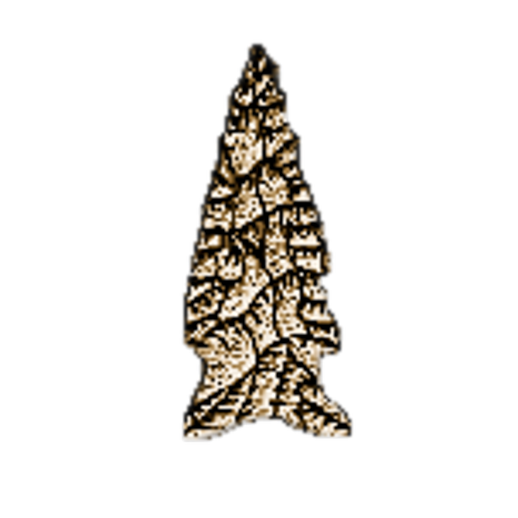
Arrowhead type
Armijo Point
Armijo3,800 - 2,800 B.P.Late Archaic5 reference photos
Key facts
- Age
- 3,800 - 2,800 B.P.
- Cultural period
- Late Archaic
- Culture
- Anasazi Culture
- Size
- Small to Medium
- Shape
- Side Notch to Auriculate
- Material
- Obsidian
- Glacial period
- Neoglacial
More from the Archaic period
Description
This lanceolate point exhibits a slender profile, characterized by a cross-section that ranges from flattened to elliptical, often with a subtle convex curvature. The blade's curvature is predominantly excurvate, frequently accompanied by serrations along its edge. The shoulders are typically subdued, angled upward, and merge with an expanding stem, which can impart an auriculate appearance to the point. The basal auricles are generally rounded, with a concave base that adds to the point's distinctive shape. Many specimens display evidence of grinding in the basal and hafting regions. The manufacturing process involves initial shaping through primary percussion flaking, followed by refinement using secondary pressure flaking, which often obscures the initial flaking scars, resulting in a complex, random flaking pattern.
Size
The arrowhead's dimensions are characterized by a total length ranging from 14 to 32 mm, with the stem portion measuring between 6 and 11 mm. The blade itself spans a width of 12 to 20 mm, while the base width falls within the range of 11 to 17 mm. In terms of thickness, the arrowhead measures between 4 and 7 mm.
Distribution
This type is mainly discovered in areas historically occupied by Ancestral Puebloans across the Colorado Plateau, spanning Utah, Colorado, Arizona, and New Mexico
Mainly found in
Additional information
The classification and characteristics of a specific type of Native American arrowhead have been the subject of ongoing discussion among archaeologists. Initially identified by Cynthia Irwin-Williams in 1973, this point was later reevaluated and redefined by Michael G. Landon in 2005. One of the challenges in categorizing this type is its resemblance to the hafting region of Pinto and San Jose points, leading some experts to question its status as a distinct type. Instead, some professionals consider it a variant of the San Jose type.
A closer examination of the characteristics of this point, however, reveals some notable differences. According to Irwin-Williams (1973), it is distinguished from the San Jose point by its wider and shorter hafting region. Additionally, this type is more frequently serrated than the San Jose point. The maximum width of this point, with a mean of 14.52 mm, as observed by Thoms (1977), suggests that it was likely used as an arrow, whereas its other characteristics imply that it may have been used as a dart. This dual functionality highlights the complexity and versatility of this point.
Further research has led to the identification of similar points, such as the "Grants point" referred to by Claudia Berry (1987). It has been proposed that the Grants point may be equivalent to the Armijo point, underscoring the need for continued investigation and clarification of the relationships between these point types. The ongoing debate surrounding the classification and characteristics of this point underscores the importance of meticulous analysis and collaboration among archaeologists to deepen our understanding of Native American material culture and technology. By examining the subtle differences and similarities between point types, researchers can gain valuable insights into the lives and traditions of the people who created and used these artifacts.
Identified by
- Named by
- Cynthia Irwin-Williams
- Year
- 1973
Similar types
Types that are easy to confuse with the Armijo point.