
Arrowhead type
Anderson Point
Anderson6,000 - 5,000 B.P.Middle Woodland2 reference photos
Key facts
- Age
- 6,000 - 5,000 B.P.
- Cultural period
- Middle Woodland
- Size
- Medium
- Shape
- Corner Notch
- Glacial period
- Middle Holocene
More from the Woodland period
Description
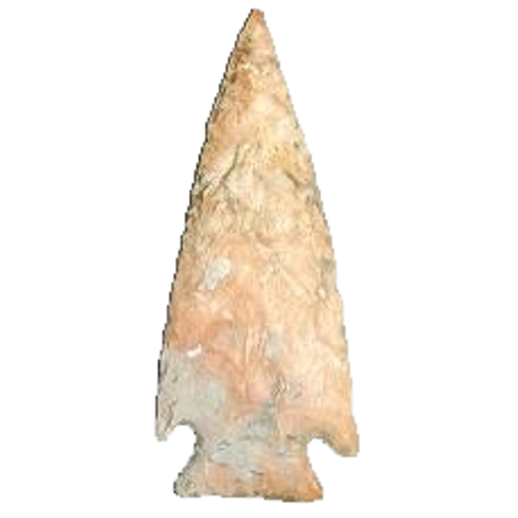
This triangular corner notch point exhibits a size range of 2 1/2 to 5 inches, characterized by an elliptical cross-sectional profile. The blade's curvature can range from a subtle excurvate shape to a straight configuration. Notably, the shoulders are adorned with barbs and feature an expanding stem. The basal edge is generally straight, although it may display minor variations, ranging from a slight concavity to a slight convexity. The flaking pattern observed on this point is random, lacking a discernible or consistent pattern.
Size
Medium
Distribution
This type is mainly discovered in regions linked to Ancestral Puebloan locations. This type may be discovered on the Colorado Plateau in the southern Manti La Sal range and southward to the Su Site of New Mexico and westward to Navajo Mountain
Mainly found in
Also found, less often, in
Additional information
In the realm of Native American arrowheads, the Anderson type, also known as Corner Notch, exhibits notable similarities with the Apple Creek type, particularly in terms of its morphological characteristics. This specific type was first identified and named by amateur archaeologist John T. Dowd in 1972. Subsequent formal descriptions were provided by archaeologists Bruce Lindstrom and Kenneth Stevenson, based on specimens unearthed at the Anderson archaeological site, designated as 40WM9, situated on the Harpeth River in Williamson County, Tennessee.
The Anderson type is distinguished by its medium to large size, ranging from 2 ½ inches to 5 inches in length, and is characterized by its straight or recurved blade edges, barbed shoulders, and distinctive corner notches. The stems of these projectiles and knives are either straight or expanded, with bases that are consistently straight. These characteristics contribute to the type's unique profile, setting it apart from other Native American arrowhead types. The distribution of the Anderson type is primarily confined to Tennessee, with a specific concentration in the region surrounding the Harpeth River.
The Anderson type's association with the Anderson archaeological site provides valuable insights into the cultural and historical context of its creation and use. As a type, it is significant not only for its distinctive morphological features but also for its role in shedding light on the technological and artistic traditions of the Native American groups that crafted these arrowheads. The similarities with the Apple Creek type, in particular, highlight the complex and dynamic nature of Native American cultural exchange and technological development, underscoring the importance of continued research and analysis in this field.
Identified by
- Named by
- Bruce Lindstrom and Kenneth Stevenson
- Year
- 1987
- Type site
- The Anderson Site (40WM9), Williamson County, Tennessee
Similar types
Types that are easy to confuse with the Anderson point.