
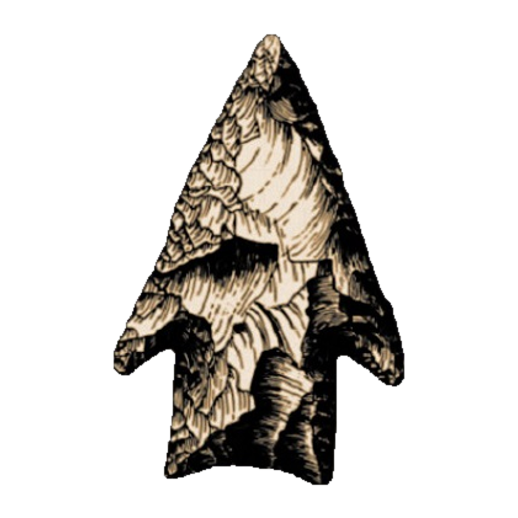
Arrowhead type
Allspice Point
Allspice4,078 - 3,835 B.P.Late Archaic5 reference photos
Key facts
- Age
- 4,078 - 3,835 B.P.
- Cultural period
- Late Archaic
- Size
- Large
- Shape
- Straight Stem
- Material
- Ceramic
- Glacial period
- Culture:
More from the Archaic period
Description
This substantial, triangular-pointed artifact features a broad blade with a straight to subtly curved profile, accompanied by an elliptical cross-sectional shape. The edges of the blade often exhibit left-handed beveling, although right-handed beveling can occur, resulting in a serrated edge in either case. The shoulders of the point are characterized by a pronounced barbed formation, intersecting the long axis at a sharp 57-degree angle. The stem tapers slightly, ranging from a subtle expansion to a gentle contraction, and terminates in a convex base. Evidence of grinding is visible in the basal region, indicating preparation for hafting. The flaking pattern on this point is distinctly oblique. A patina ranging from white to pale yellow commonly develops on the surface of this tool.
Size
The dimensions of the arrowheads are characterized by a length range of 60 to 107 millimeters, with a mean length of 78 millimeters. Additionally, the blade width varies from 31 to 44 millimeters, averaging 36 millimeters.
Distribution
This projectile was discovered in northern Belize and extended into Oaxaca Mexico. Possibly shares a similar geographic range as the Lowe point, which has been identified as far as Venezuela and northern regions of South America
Mainly found in
Additional information
The notion has been put forth that certain arrowheads may, in fact, be Lowe points that have undergone reworking. This hypothesis warrants further investigation to fully understand the characteristics and significance of these artifacts. A more in-depth analysis is necessary to determine the validity of this claim and to shed light on the cultural and historical context in which these points were created and modified.
It is essential to consider the complexities of arrowhead reworking, as it can provide valuable insights into the technological, social, and economic dynamics of the cultures that produced them. The reworking of Lowe points, in particular, may indicate a high degree of resourcefulness and adaptability among the people who created and used them. By examining the morphological and metric characteristics of these points, researchers can gain a better understanding of the processes involved in their manufacture and modification.
Further research on these potential reworked Lowe points will likely involve a multidisciplinary approach, incorporating archaeological, anthropological, and technological perspectives. Through a comprehensive analysis of the available data, scholars can hope to clarify the significance of these artifacts and their place within the broader context of Native American archaeology. Ultimately, this line of inquiry has the potential to contribute meaningfully to our understanding of the cultural and historical trajectories of the societies that produced these enigmatic arrowheads.
Identified by
- Named by
- Thomas C. Kelly
- Year
- 1993
Similar types
Types that are easy to confuse with the Allspice point.