
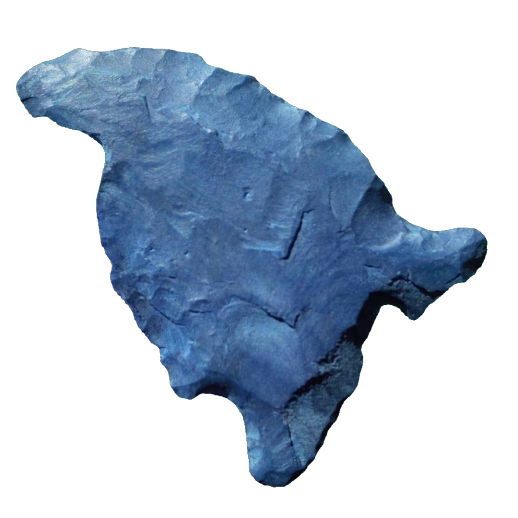
Arrowhead type
Albany Spokeshave Point
Albany Spokeshave10,000 - 7,000 B.P.Late Paleo to Early Archaic12 reference photos
Key facts
- Age
- 10,000 - 7,000 B.P.
- Cultural period
- Late Paleo to Early Archaic
- Size
- Small to Medium
- Shape
- Side Notch
- Glacial period
- Early to Middle Holocene
Description
This hafted scraper exhibits a distinctive asymmetrical profile, characterized by an elliptical cross-sectional shape. The blade's morphology is marked by a notable disparity, with one edge displaying a straight to subtly excurvate trajectory, while the opposing edge is incurvate. The presence of parallel side notches gives rise to pronounced shoulders, which are oriented horizontally or ascend at a slight angle. The stem is broadened, providing a sturdy foundation. The basal morphology varies, ranging from a subtle concavity to a gentle convexity. The flaking pattern on this scraper is characterized by a non-uniform, random arrangement of flake scars.
Size
Small to Medium
Distribution
This type is mainly discovered in eastern Texas and extending into western Louisiana. It can also be located in eastern Oklahoma and central Arkansas, albeit with lesser regularity.
Also found, less often, in
Additional information
The Albany Spokeshave, a distinctive archaeological artifact, was first described by Clarence Webb based on discoveries made at the Albany Landing Site in Louisiana. Webb's initial description highlighted two notable characteristics: the presence of water-smoothed, flat pebbles with side notches and beveling on one edge, and the possibility of reworked projectile points with similar beveling. These artifacts are commonly associated with San Patrice sites and are believed to have functioned as shaft scrapers.
Further examination of the Albany Spokeshave, also known as the Albany Knife or Scraper, reveals a small, hafted tool measuring between 1 ½ to 2 inches in length. This artifact is thought to have been part of the San Patrice toolkit, and its design suggests a specialized function, potentially as a gut hook or knife for processing game, including fish. The asymmetric shape, characterized by steep beveling on one blade edge and a rounded or needle-like tip, supports this interpretation. The presence of shallow, crudely fashioned side notches is a distinctive feature of the Albany Spokeshave, distinguishing it from other similar artifacts, such as the Edgefield, which exhibits deeper, more refined side notches.
Notably, the Albany Spokeshave was not a repurposed projectile point, but rather a unifaced tool crafted for a specific purpose. In contrast to the Edgefield, which was often salvaged or repeatedly sharpened, the Albany Spokeshave was intentionally made in its unique form, suggesting a deliberate design choice. The ground base and specialized tip of the Albany Spokeshave also imply a high degree of functionality, potentially allowing for multiple uses, including scaling and gutting. As a significant component of the San Patrice toolkit, the Albany Spokeshave provides valuable insights into the technological and cultural practices of the people who created and utilized these artifacts.
Identified by
- Named by
- Clarence Webb
- Year
- 1946
- Type site
- Albany Landing Site, Louisiana
Similar types
Types that are easy to confuse with the Albany Spokeshave point.
- Red River Knife
- San Miguel Corner Notch