
Stone tool type
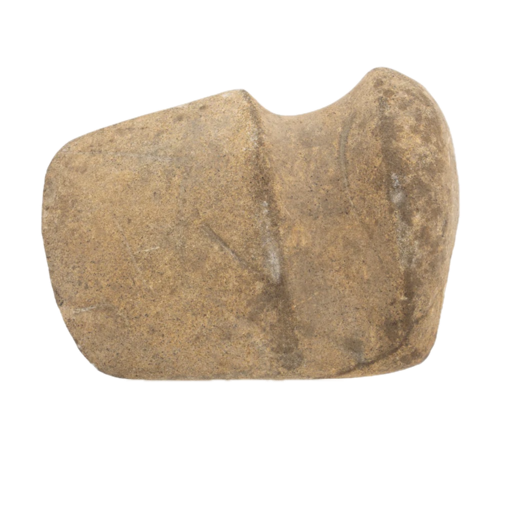
Three-Quarter Groove Axe
Three-Quarter Groove Axe5,000 - 1,500 B.P.Middle Woodland to Late Woodland cultures across the Eastern Woodlands and Midwest.5 reference photos
Key facts
- Age
- 5,000 - 1,500 B.P.
- Cultural period
- Middle Woodland to Late Woodland cultures across the Eastern Woodlands and Midwest.
- Size
- Medium to Large.
- Shape
- Ground-stone hafted axe with partial (three-quarter) circumferential groove.
- Glacial period
- Late Holocene.
More from the Woodland period
Description
A three-quarter groove axe is a ground-stone woodworking tool where the hafting groove wraps around the sides and bottom of the axe but does NOT extend completely around the top. The un-grooved top surface strengthens the head and prevents breakage. The cutting bit is ground and sharpened, and the overall shape is symmetrical and heavy. Stone materials typically include granite, diorite, basalt, and other dense igneous or metamorphic rock. This style represents a technological improvement over full-groove axes, offering stronger hafting and reduced chance of splitting.
Size
Typical length ranges from 12 to 25 cm (5 to 10 inches). Width usually ranges from 5 to 10 cm (2 to 4 inches). Thickness typically falls between 3 and 7 cm (1.25 to 3 inches). The groove cuts across both sides and the bottom but stops before reaching the top. The bit is ground smooth into a beveled cutting edge. The top is left ungrooved to provide strength. Cross-sections may be oval, rounded rectangular, or slightly wedge-shaped. Many examples show resharpening, polish, or bit wear from heavy woodworking use.
Distribution
Three-quarter groove axes are found across much of eastern and central North America. They are especially common in the Eastern Woodlands, Ohio Valley, Tennessee River Valley, the Carolinas, Georgia, Alabama, Kentucky, Indiana, Illinois, Wisconsin, Minnesota, and through the Central Plains into Kansas and Oklahoma. They also appear in East Texas woodland regions but are less common west of central Texas. They represent a widespread Woodland period hafted tool tradition.
Additional information
Three-quarter groove axes are considered more advanced than full-groove axes due to improved durability and better haft stability. The ungrooved top strengthens the axe body under impact. These tools were used for tree felling, construction, clearing land, and heavy woodworking. They often appear at Woodland village sites, mound-building areas, and seasonal camps. Many archaeologists use three-quarter groove axes as markers for increasing woodworking intensity and more permanent settlements during the Woodland period. They are commonly found in river valleys, ridge sites, and near ancient hardwood forests.