
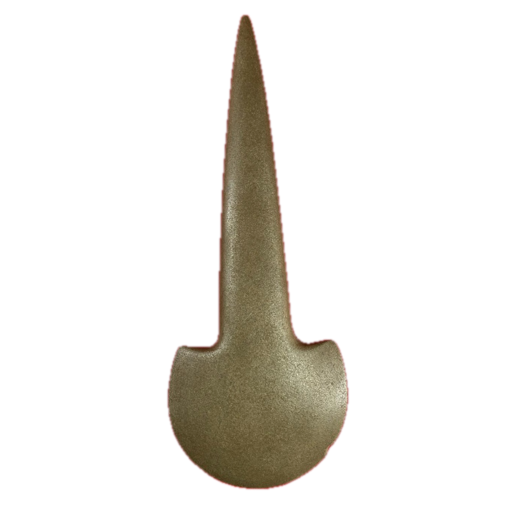
Stone tool type
Stone Spud
Stone Spud4,000 - 500 B.P.Strongly associated with Middle Woodland, Late Woodland, Adena, Hopewell, and Mississippian cultures in the Eastern Woodlands.6 reference photos
Key facts
- Age
- 4,000 - 500 B.P.
- Cultural period
- Strongly associated with Middle Woodland, Late Woodland, Adena, Hopewell, and Mississippian cultures in the Eastern Woodlands.
- Size
- Medium
- Shape
- Flattened, spatulate ground-stone tool with a flared blade and tapered handle.
- Glacial period
- Late Holocene
More from the Woodland, Mississippian periods
Description
A stone spud is a broad, flat, ground-stone tool with a flared, spatula-like blade and a narrower handle-like body. The blade is thin and flattened, while the proximal end is thicker and more compact. Spuds were used for woodworking, smoothing, hoeing light soils, stripping bark, and shaping timbers. Many show extensive polish on the working blade. Some spuds, especially highly polished or intricately shaped ones, appear to have been ceremonial objects carried by elite individuals. Materials include slate, greenstone, and other fine-grained stones suitable for grinding into a flat blade.
Size
Lengths typically range from 15 to 30 cm (6 to 12 inches). Width at the blade end often ranges from 5 to 12 cm (2 to 5 inches). Thickness generally ranges from 1 to 2.5 cm (0.4 to 1 inch). The tool is wider and thinner at the blade, tapering into a thicker, narrower proximal section that may have been inserted into a handle or held directly. The blade edge may be straight, slightly curved, or gently rounded. Many spuds have highly polished surfaces from repeated contact with wood or soil. The cross-section near the blade is typically flat or lightly convex.
Distribution
Stone spuds, also called spatulate tools, are found mainly in the Eastern Woodlands, particularly the Ohio Valley, Illinois River Valley, Kentucky, Indiana, and parts of the Southeast. They are strongly associated with Woodland and Mississippian cultures. Smaller numbers appear in the Great Lakes and the upper Mississippi region. Their distribution aligns closely with areas practicing intensive woodworking, agriculture, and mound construction. Spuds are frequently found in ceremonial contexts, caches, and high-status burials, indicating both practical and symbolic importance.
Additional information
Stone spuds served both functional and symbolic roles. Practical versions were used for woodworking, smoothing surfaces, preparing bark, and cultivating loose soils. Ceremonial spuds, often polished to a mirror-like finish, may have represented authority or ritual function. Some are interpreted as symbols of office or tools used in constructing earthworks and community structures. The spatulate design makes them immediately recognizable. Many archaeological finds occur in caches, graves, or associated with ritual artifacts. Their form also influenced later shell and bone spatulate tools in similar regions.