
Stone tool type
Pitted Stone
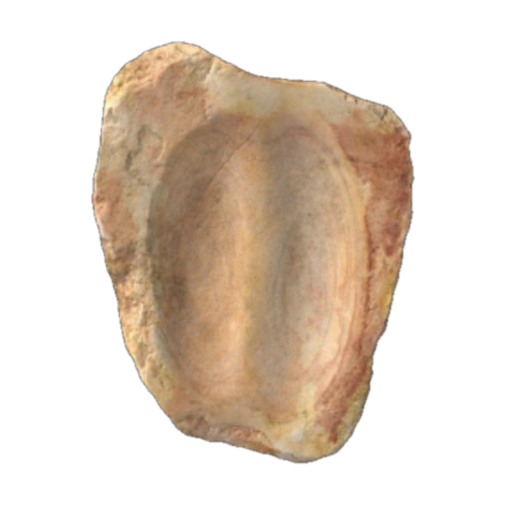
Pitted Stone8,500 - 300 B.P.Used by Archaic hunter-gatherers, Woodland societies, Mississippian cultures, Plains Village groups, and many others.2 reference photos
Key facts
- Age
- 8,500 - 300 B.P.
- Cultural period
- Used by Archaic hunter-gatherers, Woodland societies, Mississippian cultures, Plains Village groups, and many others.
- Size
- Small to Medium
- Shape
- Multipurpose pitted stone used for crushing, grinding, holding, or anchoring small items.
- Glacial period
- Late Holocene
More from the Archaic, Woodland, Mississippian periods
Description
A pitted stone is a naturally shaped or minimally modified stone featuring one or more intentionally pecked or worn depressions. These pits were used for a wide range of purposes, including cracking nuts, grinding small seeds, crushing pigments, holding small objects during tool-making, and serving as finger grips during use of a larger stone. Some pitted stones may also have functioned as anvils for knapping. The pits vary in depth and shape depending on the intended purpose, and many stones exhibit multiple pits created over long periods of use. Materials include sandstone, granite, quartzite, limestone, and other workable stones.
Size
Most pitted stones measure between 10 and 30 cm (4 to 12 inches) across. Thickness ranges from 3 to 10 cm (1 to 4 inches). Pits are typically 1 to 5 cm deep, though some are shallow depressions created by grinding motions rather than pounding. Stones may have a single pit or multiple pits arranged irregularly across one or both surfaces. Pits can be circular, oval, or more irregular depending on how they formed. Some stones are flattened, others rounded or ovoid. Many show polish, pecking marks, or micro-flaking around the depressions, indicating repeated use.
Distribution
Pitted stones occur throughout North America and are found in nearly every archaeological region. They are especially common in the Eastern Woodlands, Midwest, Great Lakes, and Plains, with additional occurrences in the Southwest and Great Basin. Their distribution covers habitats where plant processing, tool-making, and small-scale crushing tasks were part of daily life. Pitted stones are often found at campsites, knapping sites, village sites, and areas associated with grinding or crushing activities.
Additional information
Pitted stones served diverse purposes in daily activities. They were used as small anvils for cracking nuts, as depressions for holding bone or antler when shaping tools, as pigment-crushing stones for ochre or charcoal, and as stationary surfaces for fine knapping work. Some may have been used for straightening arrow shafts or holding small items while carving or drilling. Distinguishing between nutting stones and general pitted stones can be difficult; nutting stones tend to have rounder, deeper pits, while general pitted stones may have a mix of shapes and depths. Their multifunctional nature makes them one of the most commonly recovered tool types in many regions.