
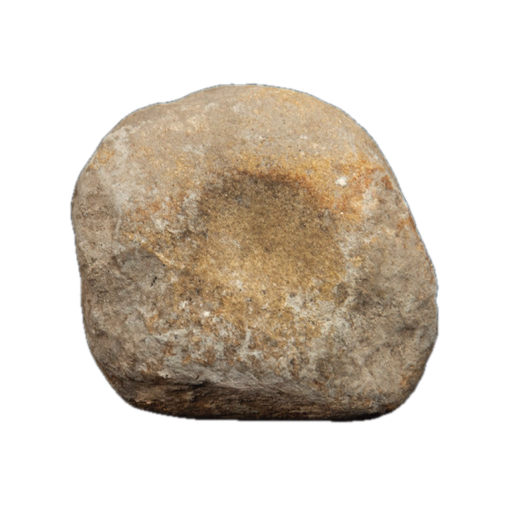
Stone tool type
Nutting Stone
Nutting Stone8,000 to 300 years B.P.Used by Archaic hunter-gatherers, Woodland cultures, Mississippian agriculturalists, and many other North American societies.8 reference photos
Key facts
- Age
- 8,000 to 300 years B.P.
- Cultural period
- Used by Archaic hunter-gatherers, Woodland cultures, Mississippian agriculturalists, and many other North American societies.
- Size
- Small to Medium
- Shape
- Pitted anvil stone used for cracking nuts or grinding seeds.
- Glacial period
- Late Holocene
More from the Archaic, Woodland, Mississippian periods
Description
A nutting stone is a naturally rounded or slightly flattened stone containing one or more shallow depressions or cup-like pits used for cracking nuts, seeds, or small bones. The pits were formed through repeated pounding with a hammerstone. Nutting stones were used as anvils; a nut was placed in the depression and struck to crack the shell. They were also used for grinding small seeds or pigments. Many nutting stones are multi-purpose and show both pitted depressions and grinding wear. Materials include sandstone, granite, limestone, quartzite, and other durable stones.
Size
Nutting stones typically measure 10 to 25 cm (4 to 10 inches) across. Thickness varies from 3 to 10 cm (1 to 4 inches). The defining feature is one or more shallow circular or oval depressions ranging from 1 to 5 cm (0.4 to 2 inches) deep. These depressions may be smooth from use or rough and pecked. Some stones have a single pit, while others contain multiple pits on both surfaces. The body of the stone may be rounded, oblong, or flattened. Many examples show signs of wear around the pits, including pecking, smoothing, or micro-flaking.
Distribution
Nutting stones are found across most of North America, with the highest concentrations in the Eastern Woodlands, Southeast, Midwest, and Great Lakes regions. They also appear throughout the Plains, Southwest, and Great Basin, but in smaller numbers. Their distribution aligns with areas where nut-bearing trees such as hickory, walnut, oak, chestnut, and pecan were abundant. Nutting stones are commonly found at base camps, seasonal camps along river valleys, upland ridge sites, and habitation areas associated with plant processing.
Additional information
Nutting stones are sometimes mistaken for simple cobbles, but the shallow pits distinguish them. These depressions represent repeated cracking of nuts or seeds. Some nutting stones show multiple pits used simultaneously or sequentially as older pits wore out. In many sites, nutting stones occur together with hammerstones, manos, and metates, indicating varied plant-processing activities. Archaeologists can often identify the species of nut processed by examining residue or wear patterns. In some regions, nutting stones also served as anvils for flint knapping or pigment grinding, demonstrating their multifunctional nature.