
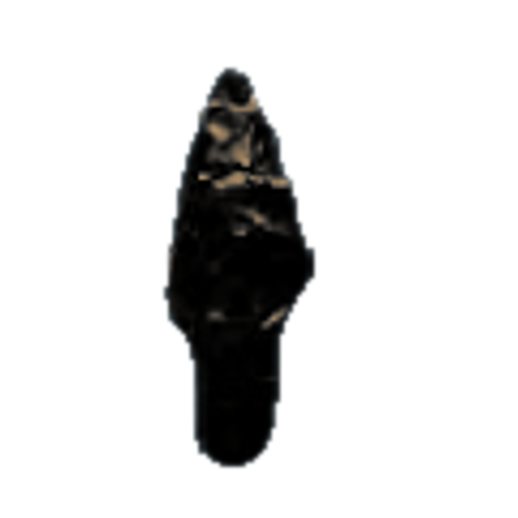
Arrowhead type
Kavik Point
Kavik2,500 - 1,200 B.P.Pre-Historic2 reference photos
Key facts
- Age
- 2,500 - 1,200 B.P.
- Cultural period
- Pre-Historic
- Culture
- Athapaskan Culture
- Size
- Small
- Shape
- Straight Stem to Contracting Stem
- Glacial period
- Modern times
Description
This triangular point features a stemmed design, with dimensions ranging from small to medium in size. Its cross-sectional profile exhibits an elliptical to median ridge shape, providing a distinctive silhouette. The blade's curvature can vary, displaying a subtle excurvate or incurvate profile. The shoulders of the point are typically angled upwards, although some specimens may exhibit a more horizontal orientation. The stem tapers inward, terminating in a base with a pronounced convex curvature. The flaking pattern observed on this point is characterized by a random, non-directional arrangement of flakes.
Size
The arrowhead's dimensions are characterized by a total length ranging from 21 to 42 mm, with the stem portion measuring between 8 to 13 mm in length, and a blade width that varies from 7 to 18 mm.
Distribution
This type is located within the Athapaskan domains of Alaska, extending into the Yukon, Northwest Territories, Alberta, and reaching the Chilcotin Plateau of British Columbia. It is typically linked to the northern portion of the Athapaskan domain (entire Athapaskan domain not illustrated on the map above)
Additional information
In the context of Alaskan archaeology, the emergence of a particular point style is considered a key indicator of the initial presence of the Athapaskan Culture, as noted by Reynolds and Jordan in their 1982 research. This significant finding highlights the importance of lithic analysis in tracing the cultural trajectory of indigenous groups. The point in question is believed to be one of the earliest manifestations of Athapaskan material culture in Alaska, providing valuable insights into the technological and stylistic developments of this ancient society.
A later point style, known as the Kamloops Side Notch, is also attributed to the Athapaskan Culture, although its distribution and usage patterns suggest a stronger association with Athapaskan territories in Canada. This geographic correlation underscores the complex dynamics of cultural exchange and migration that characterized the prehistory of North America. The Kamloops Side Notch point, with its distinctive side-notched morphology, represents a subsequent phase in the evolution of Athapaskan lithic technology, reflecting the cultural and technological adaptations of this resilient and resourceful people.
The study of these point styles offers a unique window into the lives and traditions of the Athapaskan people, who played a significant role in shaping the cultural landscape of western North America. By examining the technological, stylistic, and geographic characteristics of these artifacts, researchers can reconstruct the historical narrative of Athapaskan migration, cultural development, and interaction with other indigenous groups. As such, the analysis of these points contributes meaningfully to our understanding of the rich and diverse cultural heritage of Native American communities in Alaska and Canada.
Similar types
Types that are easy to confuse with the Kavik point.
Other types in this cluster
- Athapaskan Notched
- Kamloops Side Notch