
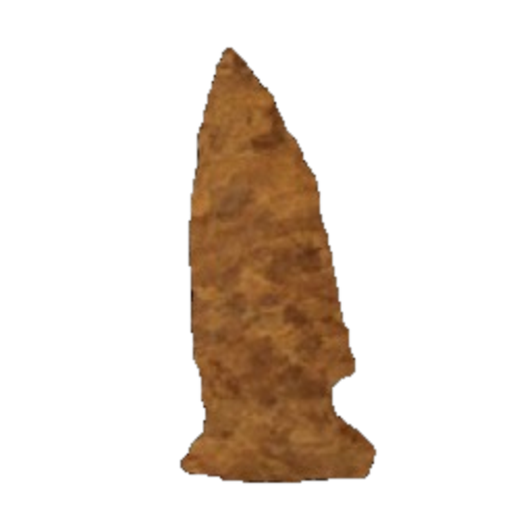
Arrowhead type
Hellgrammite Point
Hellgrammite3,000 - 2,800 B.P.Early Woodland11 reference photos
Key facts
- Age
- 3,000 - 2,800 B.P.
- Cultural period
- Early Woodland
- Size
- Small to Medium
- Shape
- Side Notch to Expanding Stem
- Material
- Jasper
- Glacial period
- Neoglacial
More from the Woodland period
Description
This triangular side notch point measures between 1 to 2 inches in length, exhibiting a slender, elongated profile with a thin, elliptical cross-section. The blade itself is characterized by a gently curved, excurvate shape, featuring fine serrations along its edges. A pair of shallow, parallel notches are situated low on the blade, giving rise to a shoulder that is subtly defined and angled upward. The stem of the point is distinctive, expanding in width to often become the broadest part of the artifact. The base of the point is marked by a straight edge, with basal corners that are smoothly rounded. In terms of flaking pattern, this point displays a random arrangement of flakes, while the hafting region typically shows evidence of grinding, suggesting intentional modification for attachment to a handle.
Size
The dimensions of the arrowheads are as follows: they range in length from 30 to 60 mm, with stem lengths varying between 5 and 9 mm. The width of the blade spans 9 to 15 mm, while the neck width measures between 7 and 13 mm. At the base, the width ranges from 13 to 20 mm.
Distribution
These artifacts are mainly discovered in the central to southern Susquehanna River basin and the southern Delaware River basin. They are occasionally located in the Juniata River basin and as far as southern Maryland and northern Virginia
Mainly found in
Also found, less often, in
Additional information
In comparison to the Meadowood point, this particular arrowhead type exhibits distinct characteristics. Notably, it tends to be longer in length, while also being more slender in overall proportions. A key feature that differentiates this point from the Meadowood is the presence of serrations along the blade's edge. This serrated pattern is a consistent trait, setting it apart from the more straightforward edge morphology of the Meadowood point.
The combination of its elongated form and thinner cross-section suggests a potential emphasis on precision and accuracy in hunting or warfare applications. The serrated blade, in particular, may have been advantageous for certain types of prey or combat situations, where the increased cutting surface area could provide a tactical advantage. Further study of this point type could offer valuable insights into the technological and cultural adaptations of the societies that produced it.
From a typological standpoint, the presence of serrations on this point's blade is a significant characteristic, as it implies a level of craftsmanship and design intentionality. The fact that this point is generally longer and thinner than the Meadowood point also underscores the diversity of arrowhead forms within Native American material culture. By examining these variations, archaeologists can gain a deeper understanding of the complex historical contexts and cultural exchange networks that shaped the development of lithic technologies in different regions.
Identified by
- Named by
- W. Fred Kinsey III
- Year
- 1959
- Type site
- Bare Island, Pennsylvania
Similar types
Types that are easy to confuse with the Hellgrammite point.