
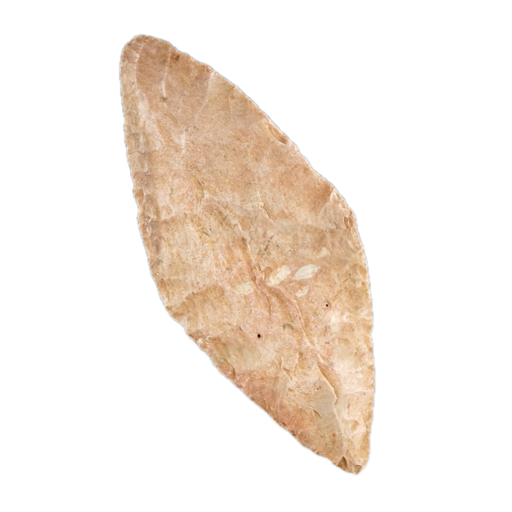
Arrowhead type
Harahey Knife
Harahey Knife5,500 - 1,800 B.P.Excellent representation of Middle and Late Archaic Plains cultures, transitioning into Early Woodland groups.3 reference photos
Key facts
- Age
- 5,500 - 1,800 B.P.
- Cultural period
- Excellent representation of Middle and Late Archaic Plains cultures, transitioning into Early Woodland groups.
- Size
- Medium to Large
- Shape
- Ovoid to Other
- Glacial period
- Late Holocene
Description
A Harahey knife is a large, thin, bifacially flaked stone knife with a broad blade and a relatively narrow, often slightly contracting base. The blade outline is typically lanceolate or ovate, with broad cutting edges suited for butchering, hide processing, and general cutting tasks. The flaking is usually well controlled, showing careful thinning and fine retouch along the edges. These knives were held in the hand or sometimes lightly hafted. Many examples show extensive edge resharpening, which gradually narrows the blade over time. They are diagnostic of Archaic Plains lithic technology and represent a versatile, multi-use cutting tool.
Size
Harahey knives typically range from 10 to 20 cm (4 to 8 inches) in length. Width often ranges from 3 to 6 cm (1.25 to 2.5 inches). Thickness generally ranges from 0.6 to 1.5 cm (0.25 to 0.6 inches). The blade is large, thin, and well-shaped, often widest near the middle. The base may be straight, slightly concave, or slightly contracting. Cross-sections are lenticular due to careful bifacial thinning. Edges frequently display fine pressure retouch. Many specimens show repeated resharpening that shifts the blade outline over time, making some late-stage examples noticeably narrower than early-stage forms.
Distribution
Harahey knives are primarily found across the Central and Southern Great Plains, with the strongest concentrations in Kansas, Oklahoma, Nebraska, and northern Texas. Examples also appear in eastern Colorado, southern South Dakota, and the Missouri River drainage. They are strongly associated with Archaic and early Woodland populations of the Plains. Their distribution overlaps with bison-hunting cultures and sites where large game processing and hide butchering took place. Harahey knives are often recovered from camp sites, kill sites, and lithic workshop areas.
Additional information
Harahey knives are a key component of the Plains Archaic toolkit. Their thin, broad blades made them ideal for butchering large animals, especially bison. Many examples were resharpened numerous times, producing edge bevels and altering the original outline. Some archaeologists consider Harahey knives to be a developmental precursor to later Plains knives. They are frequently found alongside scrapers, projectile points, and expedient flake tools. Their widespread occurrence and consistent morphology make them an important chronological and cultural marker for Plains archaeology.