
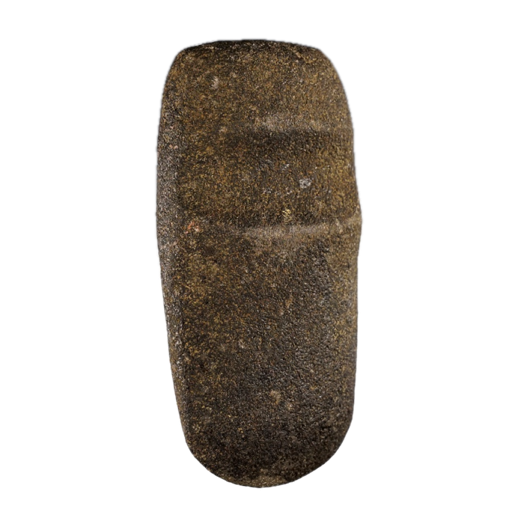
Stone tool type
Half-Groove Axe
Half-Groove Axe4,000 - 1,200 B.P.Late Archaic through Woodland peoples of the upper Midwest, central Plains, and forest-border regions.2 reference photos
Key facts
- Age
- 4,000 - 1,200 B.P.
- Cultural period
- Late Archaic through Woodland peoples of the upper Midwest, central Plains, and forest-border regions.
- Size
- Medium
- Shape
- Ground-stone axe with a bottom and partial side groove (half-groove).
- Glacial period
- Late Holocene.
Description
A half-groove axe is a ground-stone chopping tool with a groove only on the bottom and partially up both sides, but it does not wrap fully around the body. The top and much of the sides remain un-grooved. This creates a flat or slightly domed top surface that increases structural strength. The bit is ground and sharpened, while the poll end remains thicker for impact resistance. These axes were hafted with wooden handles using rawhide bindings secured around the partial groove.
Size
Length typically ranges from 12 to 22 cm (5 to 9 inches). Width often ranges from 5 to 9 cm (2 to 3.5 inches). Thickness is usually between 3 and 6 cm (1.25 to 2.5 inches). The groove is primarily along the underside, with shallow extensions up each side, forming a stable seat for hafting but leaving the upper half smooth. The bit is ground into a beveled cutting edge. The cross-section is usually oval or slightly wedge-shaped. The overall form is lighter than three-quarter groove axes and often shows bit wear or re-sharpening.
Distribution
Half-groove axes are found mainly across the central and eastern United States, but they are less common than full-groove or three-quarter-groove forms. They appear most often in the Upper Midwest (Wisconsin, Minnesota, Iowa), central Plains (Nebraska, Kansas, eastern South Dakota), and into parts of the Eastern Woodlands. They also appear in scattered contexts across Missouri, Illinois, Indiana, and Michigan. Distribution suggests they were used by groups engaged in more mobile woodland and early agricultural lifeways.
Additional information
Half-groove axes represent an intermediate design between full-groove and three-quarter-groove axe technology. They required less labor to manufacture and offered a secure hafting method without weakening the upper body of the axe. These tools were used for general woodworking, light tree felling, preparing timbers, and clearing vegetation. They are often found at seasonal camps, village sites, and workshop areas where stone grinding and polishing occurred. Their regional clustering in the Upper Midwest suggests cultural preference rather than functional necessity.