
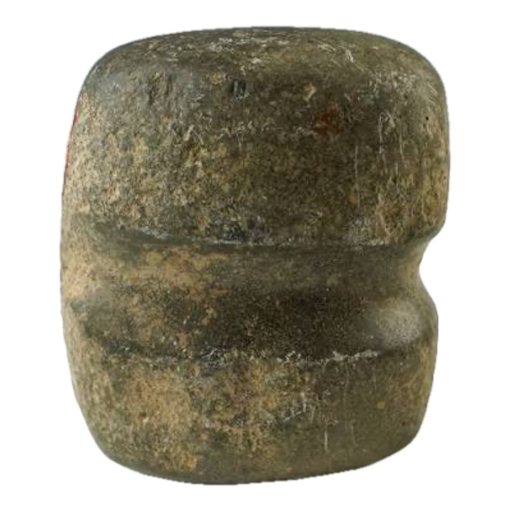
Stone tool type
Grooved Maul
Grooved Maul7,000 - 300 B.P.Used broadly by Archaic hunter-gatherers, Plains Woodland cultures, Plains Village agricultural societies, and late prehistoric bison-hunting groups.6 reference photos
Key facts
- Age
- 7,000 - 300 B.P.
- Cultural period
- Used broadly by Archaic hunter-gatherers, Plains Woodland cultures, Plains Village agricultural societies, and late prehistoric bison-hunting groups.
- Size
- Medium to Large
- Shape
- Heavy hafted hammering tool with a circumferential or partial groove.
- Glacial period
- Late Holocene
More from the Archaic, Woodland, Late Prehistoric periods
Description
A grooved maul is a large, heavy, ground or pecked stone tool used for pounding, crushing, smashing, and driving stakes. It has a distinct groove pecked around its midsection or upper third, used to haft the tool onto a wooden handle with rawhide bindings. Unlike axes, mauls do not have a cutting bit; instead, they have blunt ends designed for impact. Materials are typically granite, quartzite, basalt, or other dense stones. Mauls were essential for breaking bone, processing hides, crushing seeds, cracking nuts, shaping wood, and driving stakes or posts.
Size
Typical grooved mauls range from 12 to 30 cm (5 to 12 inches) in length. Width commonly ranges from 6 to 15 cm (2.5 to 6 inches). Weight varies widely, from 1 to over 10 pounds depending on use. Mauls are usually ovoid, rounded, or cylindrical in overall form. The groove may be encircling or partial, situated near the center or slightly above it. Ends are blunt and often show crushing, battering, or mushrooming from repeated impacts. Cross-sections are generally oval or round. Some mauls are carefully shaped; others are minimally modified but heavily used.
Distribution
Grooved mauls are found across nearly all of North America, with highest concentrations in the Great Plains, Rocky Mountains, Upper Midwest, and Canadian Prairies. They are extremely common in the Dakotas, Montana, Wyoming, Colorado, Kansas, Nebraska, and Alberta/Saskatchewan. They also appear in the Eastern Woodlands, Great Lakes, and Southwest but are less common there. Their distribution corresponds strongly with bison-hunting cultures, quarrying sites, and groups performing heavy pounding or crushing tasks.
Additional information
Grooved mauls served as general-purpose hammers for thousands of years. They were used to process plant and animal materials, drive stakes for camps and hides, break open marrow-rich long bones, and crush pigment or minerals. Many mauls broke from heavy use and the broken halves were sometimes reworked into smaller tools. Some large mauls were used two-handed with long hafts, while smaller ones were hand-held. They are common finds at bison processing sites, wooden-architecture village sites, and quarry workshops where stone was being shaped or extracted. Their heavy wear patterns tell archaeologists a great deal about daily life, subsistence, and craft practices.