
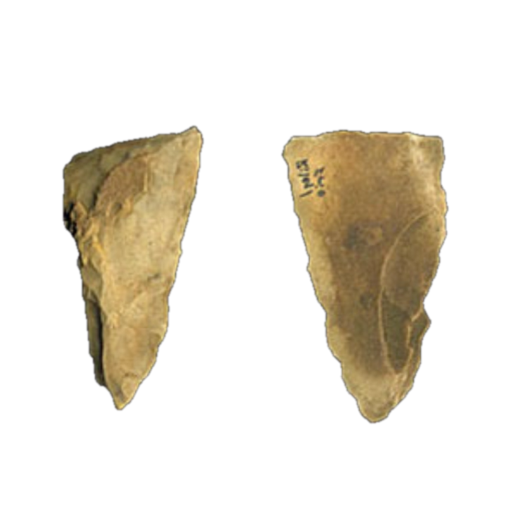
Stone tool type
Gouge
Gouge7,000 - 300 B.P.Used by Archaic hunter-gatherers, Woodland cultures, and Northeastern/Great Lakes woodworking societies.4 reference photos
Key facts
- Age
- 7,000 - 300 B.P.
- Cultural period
- Used by Archaic hunter-gatherers, Woodland cultures, and Northeastern/Great Lakes woodworking societies.
- Size
- Small to Medium
- Shape
- Curved-bevel woodworking tool with a concave cutting edge (U-gouge or V-gouge form).
- Glacial period
- Late Holocene
Description
A stone gouge is a ground- or pecked-stone tool with a concave, curved cutting edge designed for scooping, hollowing, and carving wood. It differs from a chisel by having a U-shaped or V-shaped hollow on the working edge instead of a flat bevel. This allows the tool to remove curved shavings, making it ideal for hollowing bowls, troughs, canoes, and similar wooden objects. Gouges were typically hafted into short handles and struck with mallets or used manually for finer shaping. Materials include greenstone, basalt, slate, and other fine-grained stones that can be ground into a smooth concave edge.
Size
Typical lengths range from 8 to 20 cm (3 to 8 inches). Width commonly ranges from 2 to 6 cm (1 to 2.5 inches). Thickness usually falls between 1.5 and 3.5 cm (0.5 to 1.25 inches). The working end features a ground concave hollow forming the gouge. Cross-sections near the bit may be rounded, oval, or slightly triangular, depending on the specific style. The poll end is usually thicker and may show pounding or haft wear. The edges of the concave bit are polished from repeated contact with wood. Some gouges are robust for heavy hollowing, while others are fine and narrow for precise carving.
Distribution
Stone gouges are found widely across North America but are most common in the Eastern Woodlands, Great Lakes, and Northeast. They appear frequently in New England, New York, Pennsylvania, Ohio, Michigan, Wisconsin, and Ontario. Smaller numbers occur in the Southeast, Midwest, and Pacific Northwest. Their distribution corresponds to areas where woodworking and canoe- or bowl-making traditions were strong. Gouges are often recovered from habitation sites, woodworking areas, riverine camps, and lithic workshops.
Additional information
Gouges were essential for hollowing and shaping wooden containers, canoes, mortars, troughs, and beams. Their curved edge allowed removal of deep shavings that chisels or adzes could not easily produce. Many were used in conjunction with controlled burning to soften or char wood before hollowing. Gouges show distinctive use-wear patterns including lateral polish inside the concavity and battering on the butt end from hammering. Finer gouges might be used for artistic or detailed woodworking. Broken gouges were sometimes reworked into smaller tools such as scrapers or gravers.