
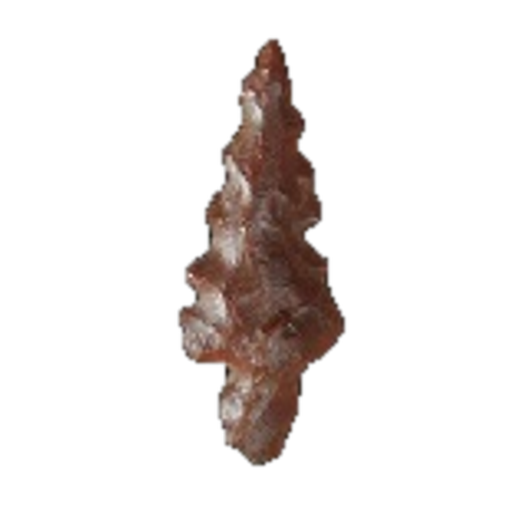
Arrowhead type
Gila River Point
Gila RiverSnaketown Cluster1,350 - 1,000 B.P.DevelopmentalKey facts
- Age
- 1,350 - 1,000 B.P.
- Cultural period
- Developmental
- Culture
- Hohokam Culture
- Size
- Small to Medium
- Shape
- Contracting Stem to Straight Stem
- Glacial period
- Vandal Minimum to Medieval
More from the Developmental period
Description
This triangular stemmed point exhibits a distinctive morphology, characterized by an elliptical cross-sectional profile. The blade's curvature can vary, ranging from a subtle outward convexity to a straight edge or a gentle inward concavity, and is notable for its pronounced serrations. These serrations are typically symmetrical, with a deeper formation near the base that gradually becomes more refined towards the apex. The blade itself is slender, often with a width equivalent to its thickness. The shoulders of the point frequently display barbed morphology, although they can also be oriented horizontally. The stem's shape can vary from a straight configuration to one that expands outward. The flaking pattern observed on this point is random, lacking a discernible order or organization.
Size
The dimensions of the arrowheads are as follows: they range in overall length from 25 to 45 mm, with stem lengths varying between 4 and 6 mm. In terms of width, the maximum width spans 10 to 15 mm, while the stem width measures between 4 and 7 mm.
Distribution
This type is mainly discovered at the Snaketown Site and adjacent areas. It has also been uncovered along the Agua Fria River, with sightings as far north as the Beardsley Canal location
Mainly found in
Additional information
In the realm of Native American arrowheads, a distinct category of points has been identified, comprising Triangular, Stemmed, and Side Notch varieties. Notably, the Gila River point, also referred to as the Snaketown Barbed, is a significant variant within this group (Justice, 2002). Although Hranicky (2011) associates these points with the Gila Butte phase, it is essential to clarify that Gila Butte denotes the cultural phase with which these points are linked, rather than serving as a formal type designation.
A closer examination of the Gila River point reveals a notable similarity to the Salt River point, with Justice (2002) highlighting the existence of a Gila River Corner Notch point. However, a key distinguishing feature between the two is the base shape: the Gila River Corner Notch point exhibits a straight base, whereas the Salt River point is characterized by a concave base. This distinction is crucial in differentiating between the two point types, as Justice's Gila River point is a distinct entity from the Gila River Corner Notch point.
The nuances in morphology and classification underscore the complexity and diversity of Native American arrowhead types. By recognizing and understanding these variations, researchers can gain valuable insights into the cultural and technological practices of the indigenous populations that crafted these artifacts. The Gila River point, in particular, offers a fascinating case study, with its associations with the Gila Butte phase and its unique characteristics, such as the Snaketown Barbed variant, providing a rich area of study for archaeologists seeking to reconstruct the lives and traditions of Native American communities.
Identified by
- Named by
- Edwin B. "Ted" Sayles
- Year
- 1965
- Type site
- Snaketown Site, Arizona
Similar types
Types that are easy to confuse with the Gila River point.
- Hodges
- Salt River
- Snaketown Side Notch
- Snaketown Stemmed
Other types in the Snaketown Cluster
- Snaketown Triangular