
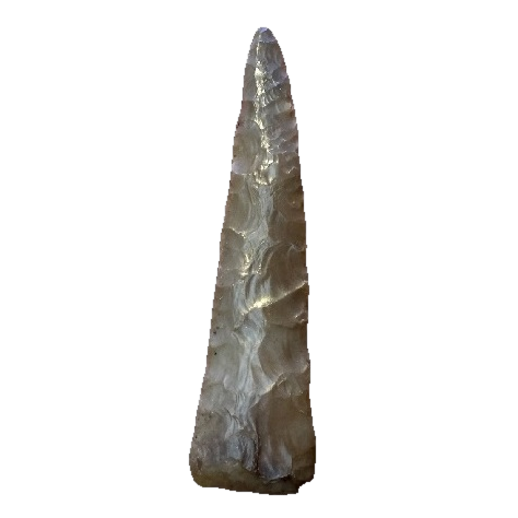
Arrowhead type
Gahagan Bi-Face Point
Gahagan Bi-Face4,000 - 1,500 B.P.Late Archaic to Late Prehistoric to Woodland13 reference photos
Key facts
- Age
- 4,000 - 1,500 B.P.
- Cultural period
- Late Archaic to Late Prehistoric to Woodland
- Culture
- Caddo, Coles Creek Culture
- Size
- Large
- Shape
- Triangle to Lanceolate
- Material
- Chert
- Glacial period
- Neoglacial to Roman Warm
More from the Archaic, Woodland, Late Prehistoric periods
Description
This triangular knife exhibits a slender profile, measuring between three to nine inches in length, with a cross-sectional morphology characterized by a flattened, thin shape. The blade's recurvate outline is marked by a series of curved sections, where the tip curves inward, followed by an outward curve towards the midpoint, and then an inward curve along the lower half, ultimately curving outward again towards the base. The base of the knife is generally straight, although it may occasionally display a slight concavity. The bi-face reduction sequence is evident in the thinning flakes that radiate outward from the preform, converging at the blade's center. Beveling is a rare occurrence, typically confined to the lower left portion of the blade. Notably, many specimens of this knife demonstrate a high level of craftsmanship. The flaking pattern on this knife is characterized by a random, non-patterned arrangement of flakes.
Size
The arrowheads exhibit a range of dimensions, with overall lengths spanning from 70 to 160 mm and basal widths varying between 35 and 75 mm.
Distribution
This type is mainly discovered in the central region of Texas, extending into the northern parts of Texas and southern areas of Oklahoma. It can also be located in western Louisiana and the southwestern section of Arkansas, albeit less commonly.
Additional information
In the realm of Native American archaeology, a particular knife has garnered significant attention for its purported use in processing plant and animal materials. According to the research conducted by Turner and Hester in 1985, this knife likely served as a versatile tool for cutting through various types of vegetable matter and meats. The design and functionality of this knife suggest a high degree of adaptability, which would have been essential for the daily subsistence activities of its original users.
Notably, this knife is thought to have undergone a process of evolution, ultimately giving rise to the distinctive Mineral Springs type. This developmental trajectory underscores the dynamic nature of Native American toolmaking traditions, where existing forms and functions were continually refined and modified to meet the changing needs of their users. By examining the characteristics and potential uses of this knife, researchers can gain valuable insights into the technological, social, and cultural contexts in which it was created and utilized.
The study of this knife and its potential evolution into the Mineral Springs type offers a fascinating window into the lives and traditions of Native American communities. Through a careful analysis of its design, materials, and functional attributes, archaeologists can reconstruct the ways in which this tool was used and valued by its original owners. Furthermore, this research contributes to a broader understanding of the complex and nuanced history of Native American technologies, highlighting the resourcefulness and ingenuity of these communities in adapting to their environments and responding to changing circumstances.
Identified by
- Named by
- Harry Shafer
- Year
- 1973
- Type site
- Gahagan Mounds, Red River Parish, Louisiana and the George C. Davis Site, Cherokee County, Texas
Similar types
Types that are easy to confuse with the Gahagan Bi-Face point.
- Covington
- Darl Blade
- Friday
- Kinney
- Mineral Springs
- Sabine
- San Gabriel