
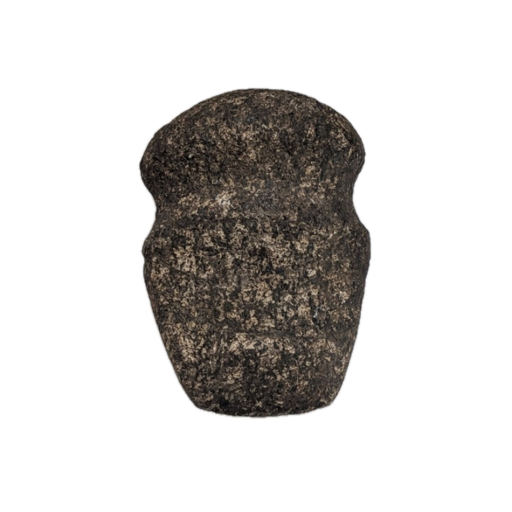
Stone tool type
Full-Groove Axe
Full-Groove Axe7,500 to 3,000 B.P.Archaic to Early Woodland5 reference photos
Key facts
- Age
- 7,500 to 3,000 B.P.
- Cultural period
- Archaic to Early Woodland
- Size
- Medium to Large
- Shape
- Ground-Stone Hafted Axe (Full Circumferential Groove)
- Glacial period
- Late Holocene
Description
A full-groove axe is a ground-stone chopping tool with:
A complete groove encircling the entire body for hafting
A bit (cutting edge) ground smooth and sharpened
A heavy, symmetrical form used for chopping, felling trees, and woodworking
Typically made from granite, diorite, basalt, greenstone, or other tough igneous/metamorphic stone
This is one of the earliest standardized ground-stone tool forms in North America.
Size
Typical characteristics:
Length:
10–25 cm (4–10 in)
Larger examples may exceed 30 cm (12 in)
Width:
5–10 cm (2–4 in)
Thickness:
3–7 cm (1.25–3 in)
Groove:
Cut fully around the entire circumference
Usually placed in the upper third
Deep and well-defined for tight hafting
Bit / Edge:
Ground to a sharp bevel
Symmetrical and durable
Shows polish and resharpening wear on used examples
Cross-section:
Rounded, oval, or slightly rectangular
Full-groove axes are heavy-duty tools designed for major woodworking tasks.
Distribution
Full-groove axes occur widely across most of North America, with highest concentrations in:
Eastern Woodlands (Ohio Valley, Mississippi Valley, Appalachians)
Midwest & Great Lakes
Southeastern U.S. (Alabama, Georgia, Tennessee, Carolinas)
Central Plains (Kansas, Oklahoma)
Texas (especially East Texas woodland zones)
Southern Canada (Ontario, Manitoba woodland regions)
They appear in nearly all forested regions where heavy woodworking was required.
Additional information
Full-groove axes are the earliest grooved axe form; later styles evolve into 3/4 groove and ungrooved celt forms.
The encircling groove allowed for strong, secure hafting with wooden handles and rawhide bindings.
Commonly found near:
River terraces
Old woodlands
Quarry sites
Long-term campsites
Many show edge resharpening, indicating long use-life.
Often misidentified, but true full-groove axes always have the groove all the way around.