
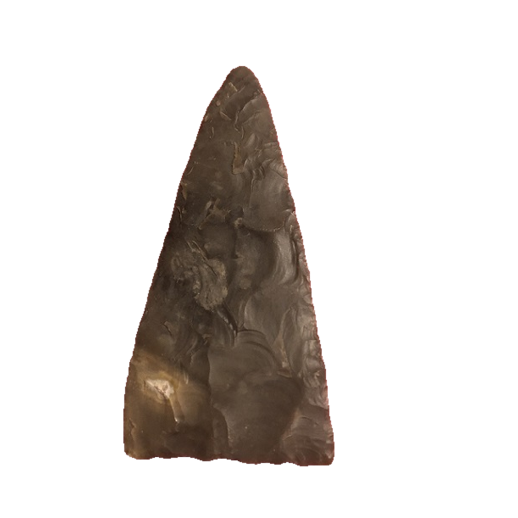
Arrowhead type
Friday Bi-Face Point
Friday Bi-Face4.000 - 1,500 B.P.Late Archaic to Late Prehistoric19 reference photos
Key facts
- Age
- 4.000 - 1,500 B.P.
- Cultural period
- Late Archaic to Late Prehistoric
- Size
- Medium to Large
- Shape
- Triangle to Lanceolate
- Glacial period
- Neoglacial to Roman Warm
More from the Archaic, Late Prehistoric periods
Description
This triangular knife exhibits a size range from medium to very large, characterized by a cross-sectional profile that transitions from flattened to elliptical. The blade's excurvate shape is a notable feature, often presenting a triangular silhouette that can vary in form. In some instances, the tip may curve inward with parallel sides, while in others, the curvature at the tip is accompanied by a secondary curvature at the base. The base of the knife typically maintains a straight alignment, although occasional variations may result in a concave shape. A distinctive attribute of this knife's base is the presence of thinning, achieved through the removal of several broad, thin flakes. The overall craftsmanship of the knife is of high quality, as evidenced by the fine workmanship and a flaking pattern that appears random in its arrangement.
Size
The dimensions of the arrowheads are characterized by a total length ranging from 70 to 180 mm and a blade width spanning from 30 to 60 mm.
Distribution
This type is mainly located in the central region of Texas. It can also be discovered in southern Oklahoma and southwestern Arkansas, albeit less commonly.
Additional information
In the realm of Native American arrowheads, a distinct type bears a notable resemblance to the Covington Blade, with a key difference lying in the basal morphology. Specifically, this particular point type is characterized by a base that can range from concave to straight, presenting a contrasting profile when compared to the Covington Knife. The latter is distinguished by its convex base, highlighting the subtle yet significant variations that exist within the broader category of arrowhead types.
The distinction between these two forms underscores the importance of meticulous observation and classification in archaeological analysis. By recognizing and documenting such differences, researchers can gain a deeper understanding of the technological, cultural, and historical contexts in which these artifacts were created and utilized. The presence of a concave to straight base in this point type, as opposed to the convex base of the Covington Knife, may reflect variations in functional requirements, stylistic preferences, or regional traditions, among other factors.
Further study of these arrowhead types can provide valuable insights into the lives and traditions of the Native American communities that crafted them. By examining the morphological characteristics, such as the basal shape, and considering the cultural associations and historical contexts, archaeologists can reconstruct a more nuanced and detailed picture of the past. The comparison between this point type and the Covington Blade and Knife serves as a testament to the complexity and diversity of Native American material culture, highlighting the need for continued research and analysis to uncover the stories and significance behind these ancient artifacts.
Identified by
- Named by
- Edward B. Jelks
- Year
- 1962
Similar types
Types that are easy to confuse with the Friday Bi-Face point.
- Covington
- Cleburne
- Darl Blade
- Gahagan
- Kinney
- Mineral Springs
- Sabine
- San Gabriel