
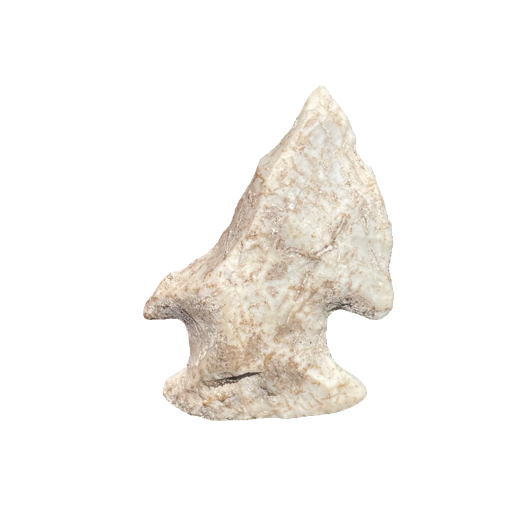
Arrowhead type
Edgefield Scraper
Edgefield Scraper9,000 - 7,000 B.P.Early Archaic12 reference photos
Key facts
- Age
- 9,000 - 7,000 B.P.
- Cultural period
- Early Archaic
- Size
- Medium to Large
- Shape
- Side Notch to Corner Notch to Other
- Glacial period
- Early to Middle Holocene
More from the Archaic period
Description
This triangular point measures between 1.25 and 1.75 inches in length, characterized by a stemmed to expanding stem morphology and a flattened cross-sectional profile. The blade exhibits a predominantly straight orientation, culminating in a sharp, well-defined tip. The stem is notable for its elongated shape and subtle expansion, while the base displays a range of configurations, from straight to mildly convex. The flaking pattern observed on this point is random, lacking a discernible order or sequence.
Size
Medium to Large
Distribution
This scraper is predominantly linked to the coastal regions of the Gulf. Dunnell et al (1970) documents its presence at the Sloan Site in Pike County, Kentucky. The distribution of this type stretches into Texas, where it is also known as Albany or Albany-Edgefield. Converse (1994) notes its occurrence throughout the Ohio River Valley. This type may have a broader range than indicated above
Mainly found in
Also found, less often, in
Additional information
In a notable study published in 1994, Converse shed light on a distinctive Early Archaic artifact known as the "Hafted Shafted Scrapper". This particular tool was discovered throughout the expansive Ohio River Basin, a region that spans multiple states and has yielded a wealth of archaeological treasures. Interestingly, further analysis revealed that the Hafted Shafted Scrapper bears a striking resemblance to another artifact, the Edgefield Scrapper, which has been found in the Gulf Coastal region. This similarity highlights the potential for cultural exchange or migration between these two geographic areas during the Early Archaic period, underscoring the complex and dynamic nature of Native American societies at that time.
The discovery of the Hafted Shafted Scrapper in the Ohio River Basin provides valuable insights into the lives and traditions of the region's early inhabitants. The fact that this artifact is also found in the Gulf Coastal region, associated with the Edgefield Scrapper, suggests a possible connection between the two cultures. This connection could have been facilitated by trade networks, migration patterns, or other forms of cultural exchange, which would have allowed for the sharing of ideas, technologies, and tools. The Hafted Shafted Scrapper, as a tool, would have played a significant role in the daily lives of these early societies, likely used for tasks such as processing hides, woodworking, or other essential activities.
The study of the Hafted Shafted Scrapper and its counterpart, the Edgefield Scrapper, contributes to our understanding of the technological and cultural developments of Native American societies during the Early Archaic period. By examining the distribution, design, and function of these artifacts, archaeologists can reconstruct the social, economic, and environmental contexts in which they were created and used. This, in turn, provides a more nuanced and comprehensive picture of the lives and experiences of Native American communities, highlighting their resourcefulness, adaptability, and resilience in the face of changing environments and cultural exchange.
Identified by
- Named by
- James L. Mitchie
- Year
- 1978
Similar types
Types that are easy to confuse with the Edgefield Scraper point.
- Albany Scrapper