
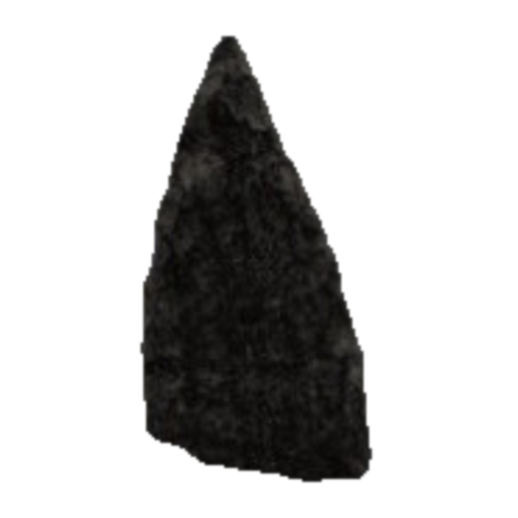
Arrowhead type
Duwamish Point
DuwamishWestern Triangle Cluster1,800 - 1,100 B.P.Pre-Historic4 reference photos
Key facts
- Age
- 1,800 - 1,100 B.P.
- Cultural period
- Pre-Historic
- Culture
- Late Marpole phase
- Size
- Medium
- Shape
- Triangle
- Glacial period
- Roman Warm to Vandal Minimum
Description
This triangular point exhibits a medium-sized, scalene shape, characterized by an elliptical cross-section of slender proportions. The blade's curvature is excurvate, with a notable asymmetry between the two edges, where one edge extends beyond the other. A subtle indentation often appears near the basal corner of the longer edge, although its presence can be inconsistent. The basal edge is angled, displaying variability in its profile, which can range from straight to mildly convex or concave. In some instances, a faint, central basal notch may be observed. The flaking pattern on this point is random, lacking a discernible, organized arrangement.
Size
The arrowheads exhibit a range of dimensions, with lengths spanning 29 to 64 mm, and averaging between 38 to 49 mm. The blade widths vary from 13 to 33 mm, with an average range of 21 to 27 mm. In terms of proportion, the width-to-length ratio falls between 0.34 and 0.84, with an average ratio of 0.48 to 0.64.
Distribution
This arrowhead type was discovered at the Duwamish No. 1 location, Chester Morse location, and Hartstene location within the Puget Sound area of Washington and British Columbia. It has also been identified in numerous locations throughout the Gulf, San Juan Islands, and Pedder Bay location of the Puget Sound. It can be encountered across southwestern British Columbia and extending into northwestern Washington. The complete range remains uncertain
Mainly found in
Additional information
More information needed.
Identified by
- Named by
- Dale R. Croes
- Year
- 2011
- Type site
- Duwamish No.1 site, British Columbia
Similar types
Types that are easy to confuse with the Duwamish point.
- Helen Point
- Salish Triangle