
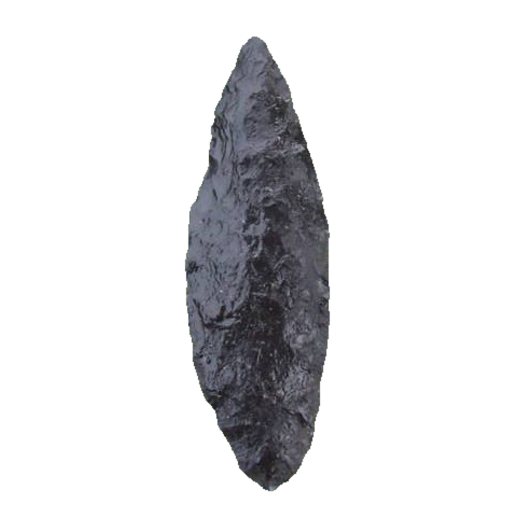
Arrowhead type
Dutch Harbor Ovoid Point
Dutch Harbor Ovoid5,000 - 200 B.P.2 reference photos
Key facts
- Age
- 5,000 - 200 B.P.
- Culture
- Aleutian Tradition
- Size
- Medium to Large
- Shape
- Ovoid
- Material
- Basalt
Description
This lanceolate point exhibits a medium to large size profile, characterized by an elliptical cross-sectional shape. The blade's morphology is marked by an excurvate shape, where the tip initially curves inward before transitioning into a nearly parallel segment, spanning approximately one-third to two-thirds of the blade's length. The curvature then reverses, converging inward toward the base, which presents a convex outline. The flaking pattern observed on this point is random, lacking a discernible or systematic arrangement of flake scars.
Size
Medium to Large
Distribution
This type is located in the Dutch Harbor area and the southern islands of Alaska.
Mainly found in
Additional information
In the realm of Native American arrowheads, a particular point of interest bears a striking resemblance to the Cascade type, commonly found in the Pacific Northwest region of the United States and extending into Canada. Notably, the Cascade points are categorized as an older type, distinguished by their unique characteristics and temporal significance. This classification underscores the importance of understanding the chronological context in which these arrowheads were crafted and utilized.
The similarity between this point and the Cascade type is a significant aspect of its identification, as it highlights the shared technological and stylistic traditions among the indigenous cultures of the Pacific Northwest and beyond. The fact that Cascade points are considered an older type suggests that they may have been produced during a earlier period, potentially influencing the development of subsequent point styles in the region. This insight underscores the value of examining the typological and chronological relationships between different arrowhead types, as it can provide a more nuanced understanding of the cultural and historical contexts in which they were created.
The study of arrowheads like this one, with its affinity to the Cascade type, offers a fascinating glimpse into the lives and traditions of Native American communities in the Pacific Northwest and Canada. By examining the characteristics and distribution of these points, archaeologists can gain a deeper appreciation for the complex cultural dynamics and technological innovations that shaped the region's prehistory. As researchers continue to explore and analyze these artifacts, they may uncover new insights into the lives and traditions of the people who crafted and used them, ultimately enriching our understanding of the rich and diverse cultural heritage of Native American communities.
Similar types
Types that are easy to confuse with the Dutch Harbor Ovoid point.
- Chignik Ovoid
- Mesa
- Portage
- Rat Island