
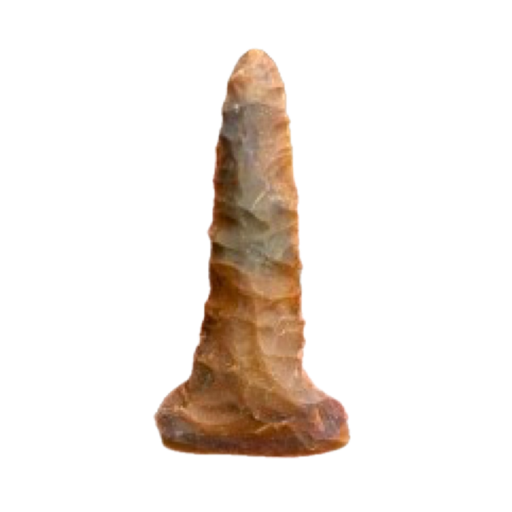
Arrowhead type
Drill / Perforator
Drill / Perforator6,000 - 300 B.P.Widely used by Archaic foragers, Woodland craft-producing societies, Mississippian shell-working cultures, Ancestral Puebloans, Mogollon groups, Plains Village peoples, and nearly every region where bead making, pottery decoration, or woodworking occurred.2 reference photos
Key facts
- Age
- 6,000 - 300 B.P.
- Cultural period
- Widely used by Archaic foragers, Woodland craft-producing societies, Mississippian shell-working cultures, Ancestral Puebloans, Mogollon groups, Plains Village peoples, and nearly every region where bead making, pottery decoration, or woodworking occurred.
- Size
- Small to Medium to Large
- Shape
- Other
- Glacial period
- Late Holocene
More from the Archaic, Woodland, Mississippian periods
Description
A stone drill is a narrow, elongated stone tool with a pointed or tapered working end used for boring holes into wood, bone, shell, leather, soft stone, and pottery. Many drills were manufactured by modifying existing projectile points, snapping and reworking the tips, or reshaping broken blades into narrow, durable shafts. Others were purpose-made, flaked into long, symmetrical, needle-like forms. Drills were often used with a hand-twirling technique or inserted into a wooden shaft to create a simple rotary drill. Their form varies by region, but all share a narrow, pointed working end and a strong midsection designed to withstand rotational pressure.
Size
Stone drills typically range from 3 to 10 cm (1.25 to 4 inches) in length. Width commonly ranges from 0.5 to 2 cm (0.25 to 0.75 inches). The working tip is sharply pointed or tapered, often produced through fine-pressure flaking along the edges. Some drills have a round or triangular cross-section, while others are flat and blade-like. Base styles may resemble small projectile points, notched points, or reworked stemmed points. Evidence of reworking is common: many drills show snapped bases, repurposed notches, or pressure-flaked edges that indicate the tool started as a broken arrowhead or knife fragment. Rotation wear sometimes produces polish or striations near the tip.
Distribution
Stone drills are found across all of North America, with especially high concentrations in the Midwest, Great Plains, Eastern Woodlands, and Southwest. They frequently occur at village sites, campsites, tool-making workshops, and areas with shell bead production. Identified examples appear from the Archaic period onward, but they become especially common during Woodland and Mississippian times when shell, bone, and wood working intensified. Drills are also documented in Ancestral Puebloan and Mogollon craft sites associated with pottery decoration and bead making.
Additional information
Many arrowhead drills were made by snapping the tip of a damaged point and grinding or pressure-flaking it into a narrow perforator. This recycling behavior is common in archaeological collections and explains the wide range of shapes. Drills were used for making holes in shell beads, bone tools, leather clothing, basketry components, and wooden shafts. Rotary-style drills often show rotational polish or micro-chipping around the tip. Some regions produced specialized forms, such as double-ended drills or thick midsections for hafting into drill shafts. Drills are important indicators of craft activities and bead production at prehistoric sites.