
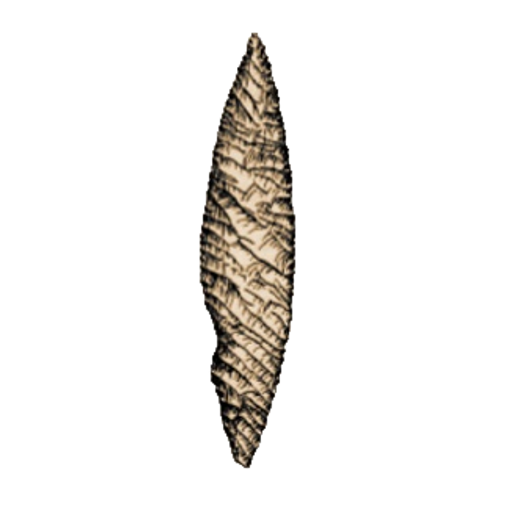
Arrowhead type
Denbigh Point
Denbigh6,000 - 4,000 B.P.3 reference photos
Key facts
- Age
- 6,000 - 4,000 B.P.
- Culture
- Arctic Small Tool Tradition
- Size
- Medium
- Shape
- Lanceolate
- Glacial period
- Neoglacial
Description
This lanceolate point exhibits a medium-sized, ovoid silhouette, characterized by an elliptical profile. The blade's morphology is predominantly excurvate, with a distinctive curvature that converges at the apex, transitions into a parallel segment, and then recurves inward as it approaches the base. The basal morphology is typically pointed, although some specimens display a straight base. The flaking pattern is marked by a prevalence of oblique or parallel horizontal removals, which impart a distinctive texture to the point's surface.
Size
Medium
Distribution
The Denbigh Culture emerged in Siberia and established temporary settlements in western Alaska, proceeding to venture into the Canadian Arctic and extending as far as Greenland.
Additional information
The archaeological record of the Denbigh culture reveals a distinctive array of lithic artifacts, including projectile points and knives. Notably, many of these tools exhibit a bi-pointed morphology, characterized by symmetrical tips. However, a subset of these artifacts features a straight base, deviating from the more common bi-pointed form. A closer examination of the Denbigh Flint Complex, a significant component of this cultural assemblage, yields a specific type of stemmed point known as the Kayuk point. These points are a hallmark of the Denbigh culture's technological and stylistic repertoire, offering valuable insights into the lives and traditions of the people who crafted them.
The presence of bi-pointed and straight-based points within the same cultural context highlights the complexity and diversity of the Denbigh toolkit. This variability may reflect differences in functional requirements, raw material availability, or even social and symbolic factors. The Kayuk points, in particular, demonstrate a high degree of craftsmanship and attention to detail, suggesting a well-developed understanding of flint knapping techniques among Denbigh culture practitioners. As such, these artifacts provide a unique window into the technological, social, and cultural dynamics of this ancient society.
The study of Denbigh culture artifacts, including the Kayuk points and other bi-pointed tools, contributes significantly to our understanding of the region's prehistory. By examining the formal and technological characteristics of these artifacts, researchers can reconstruct the cultural and historical contexts in which they were created and used. This, in turn, enables a more nuanced appreciation of the lives and experiences of the people who produced and utilized these tools, shedding light on the complexities and richness of Native American cultural heritage.
Identified by
- Named by
- Louis Giddings
- Year
- 1951
Similar types
Types that are easy to confuse with the Denbigh point.
- Chignik Leaf
- Dutch Harbor Bi-Point
- Xilju
- Yukon Bi-Point