
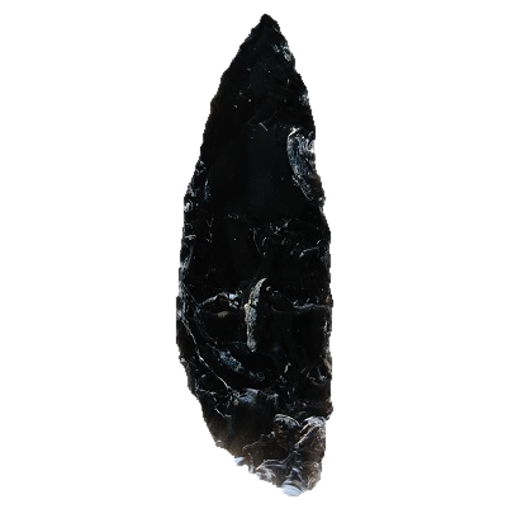
Arrowhead type
Crescent Knife - Paleo
Crescent Knife - Paleo11,000 - 9,000 B.P.Middle Archaic11 reference photos
Key facts
- Age
- 11,000 - 9,000 B.P.
- Cultural period
- Middle Archaic
- Size
- Medium to Large
- Shape
- Other
- Glacial period
- Late Pleistocene to Early Holocene
More from the Archaic period
Description
This artifact presents as a compact, curved knife, characterized by a crescentic morphology. Its cross-sectional profile is notably elliptical, transitioning to a plano-convex shape. The blade's edges exhibit contrasting curvature, with one edge displaying an excurvate profile, while the opposing edge is incurvate. The overall shape of the knife is reminiscent of a lunar crescent or a butterfly silhouette, showcasing a distinctive, asymmetrical form.
Size
Medium to Large
Distribution
These artifacts are mainly discovered in the Black Rock Desert of northwestern Nevada and extending into Oregon and California, but can also occur in other notable regions with lesser regularity.
Mainly found in
Also found, less often, in
Additional information
In the realm of Native American archaeology, a notable category of arrowheads has been unearthed in conjunction with other significant point types, including Black Rock Concave and Clovis points. A prominent discovery was made at the Fenn Cache, located in northeastern Utah, where these arrowheads were found in association with the aforementioned point types. Despite being discovered alongside Clovis points, which date back to the earliest human presence in the Americas, these arrowheads are more closely linked to the Great Basin Stemmed Cluster and the Western Stemmed Tradition points. This cultural affiliation is further reinforced by their geographic distribution, which mirrors that of the Great Basin Stemmed Cluster, yet remains distinct from the Clovis distribution, suggesting a unique cultural and temporal context.
The distribution of these arrowheads is a significant aspect of their study, as it provides insight into the migration patterns and cultural exchange networks of the indigenous populations that created them. The fact that they do not extend into the Clovis distribution area implies a distinct cultural or temporal boundary, highlighting the complexity of the archaeological record in North America. By examining the co-occurrence of these arrowheads with other point types, researchers can gain a deeper understanding of the technological, social, and cultural developments that characterized the lives of Native American communities during this period.
The Fenn Cache discovery, in particular, offers a valuable window into the lives of these ancient communities, providing a unique opportunity to study the material culture and technological traditions of the Great Basin Stemmed Cluster and Western Stemmed Tradition. Through the analysis of these arrowheads and their associated point types, archaeologists can reconstruct the cultural and historical contexts in which they were created, shedding light on the intricate relationships between technology, culture, and environment that defined the lives of Native American communities in the region.
Identified by
- Named by
- C. W. Clewlow Jr.
- Year
- 1968
- Type site
- Blackrock Desert, Nevada