
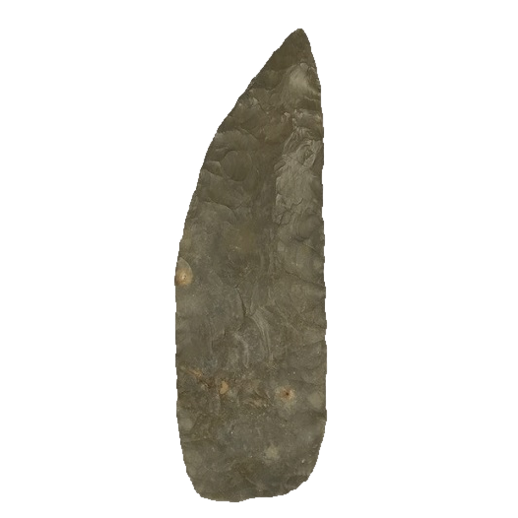
Arrowhead type
Crescent Knife - Archaic
Crescent Knife - Archaic9,000 - 5,000 B.P.Paleo13 reference photos
Key facts
- Age
- 9,000 - 5,000 B.P.
- Cultural period
- Paleo
- Size
- Small to Medium
- Shape
- Other
- Glacial period
- Early Holocene to Middle Holocene
More from the Paleo period
Description
This knife exhibits a distinctive crescentic morphology, characterized by a medium to large size and a cross-sectional profile that transitions from elliptical to plano-convex. The blade's edges display contrasting curvatures, with one edge presenting an excurvate shape, while the opposite edge is incurvate, resulting in a unique, asymmetrical silhouette that evokes the shape of a crescent moon or a butterfly.
Size
Small to Medium
Distribution
The entire range remains unclear, but these arrowheads are mainly linked to Texas, extending into New Mexico, Coahuila, and Chihuahua Mexico. They have also been discovered in the Tennessee River Valley and across the southern grasslands.
Mainly found in
Also found, less often, in
Additional information
The designation of this particular artifact is derived from its distinctive shape, which bears a striking resemblance to earlier knives discovered in Nevada and the surrounding areas. This naming convention is a testament to the regional consistency in tool design, highlighting the cultural and technological exchange that occurred among ancient societies in this geographic locale. By drawing parallels with older, similarly named knives, researchers can gain a deeper understanding of the evolutionary trajectory of tool development in this region, shedding light on the lives and traditions of the indigenous peoples who crafted these artifacts.
The presence of these knives in Nevada and the surrounding region suggests a high degree of cultural continuity and cooperation among the Native American groups that inhabited this area. The fact that these tools share a common name and design implies a shared cultural heritage, with knowledge and techniques being passed down through generations. This phenomenon is a hallmark of the complex and dynamic societies that existed in this region, where the exchange of ideas and innovations played a crucial role in shaping the course of technological and cultural development.
The study of these knives offers a unique window into the lives of the people who created them, providing valuable insights into their daily activities, subsistence strategies, and social interactions. By examining the design, materials, and distribution of these artifacts, archaeologists can reconstruct a more nuanced picture of the cultural and historical context in which they were used, ultimately enriching our understanding of the rich and diverse cultural landscape of Native America.