
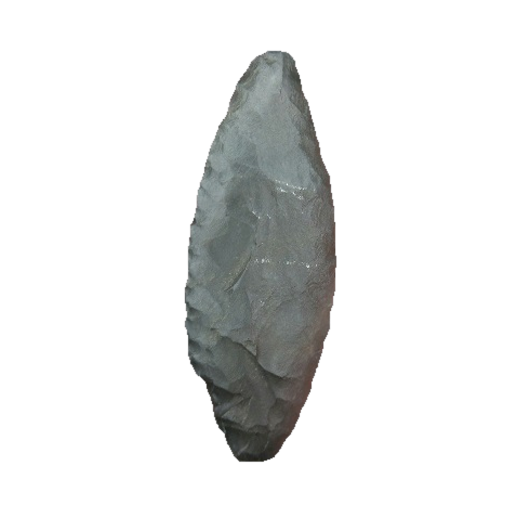
Arrowhead type
Coquille Knife
Coquille Knife4,500 - 700 B.P.Middle Archaic to Developmental2 reference photos
Key facts
- Age
- 4,500 - 700 B.P.
- Cultural period
- Middle Archaic to Developmental
- Size
- Medium
- Shape
- Auriculate to Lanceolate to Triangle
- Glacial period
- Neoglacial to Medieval Warm
More from the Archaic, Developmental periods
Description
This knife exhibits a distinctive medium-sized triangular to lanceolate morphology, characterized by an elliptical cross-sectional profile. The blade's curvature is notably excurvate, often displaying a pronounced inward curve at the distal tip, which then reverses direction, sweeping back towards the proximal base. The base itself typically presents a straight edge, accompanied by basal corners that are smoothly rounded. In terms of flaking pattern, this knife features a random arrangement of flakes, lacking a discernible or deliberate sequence.
Size
The dimensions of these arrowheads are characterized by a total length ranging from 41 to 72 mm and a blade width spanning 23 to 29 mm, as determined from a limited dataset.
Distribution
This type is mainly discovered in the Coquille River area of southwest Oregon and extending into northern California
Mainly found in
Additional information
More information needed.
Identified by
- Named by
- Thomas J. Connelly
- Year
- 1986
- Type site
- Standly Site, Oregon
Similar types
Types that are easy to confuse with the Coquille Knife point.
- Cascade
- Mahkin Shouldered