
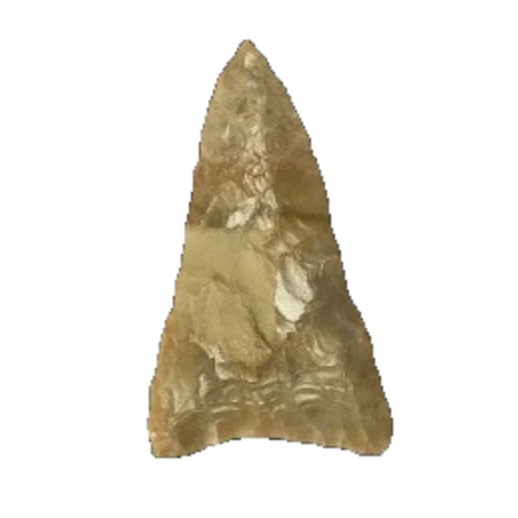
Arrowhead type
Columbia Mule Ear Point
Columbia Mule Ear700 - 400 B.P.Classic13 reference photos
Key facts
- Age
- 700 - 400 B.P.
- Cultural period
- Classic
- Culture
- Umitilla Culture
- Size
- Small
- Shape
- Triangle to Lanceolate
- Glacial period
- Medieval
More from the Preclassic and Classic period
Description
The artifact exhibits a compact, angular morphology, ranging from triangular to pentagonal in shape, with a distinctive elliptical profile in cross-section. Its asymmetrical outline is often accentuated by a recurvate or incurvate curvature, lending a dynamic quality to its overall form. The basal edge varies in curvature, spanning a spectrum from subtle concavity to pronounced inward curvature. The flaking pattern that covers the surface of this point is characterized by a non-directional, random arrangement of scars.
Size
The arrowheads exhibit the following dimensional characteristics: overall length ranges from 34 to 55 mm, with a mean length of 36 to 41 mm. The maximum width of the blade varies between 19 to 41 mm, averaging 23 to 28 mm. Additionally, the basal concavity measures between 3 to 7 mm.
Distribution
This type is mainly located in the southern areas of the Columbia Plateau, although it can also occur less often in the central to northern parts of the Columbia Plateau.
Mainly found in
Additional information
The Mule Ear point derives its name from its distinctive appearance, which emerges after undergoing multiple re-sharpening processes. This characteristic shape is a result of the intentional reworking of the artifact, likely to extend its functional lifespan. As noted by Heath in 2003, the Mule Ear point's unique form is a testament to the resourcefulness and ingenuity of its creators, who carefully re-sharpened and reconfigured the tool to maintain its effectiveness. This phenomenon offers valuable insights into the technological and cultural practices of the people who crafted and utilized these points, highlighting their ability to adapt and reuse materials to meet their needs.
Identified by
- Named by
- Douglas Osborne
- Year
- 1952
- Type site
- The Sheep Island site, Chief Joseph Reservoir, Washington
Similar types
Types that are easy to confuse with the Columbia Mule Ear point.
- Owl Cave
- Plateau Pentagonal
- Salish Triangular
- Strong
- Triangular Knife