
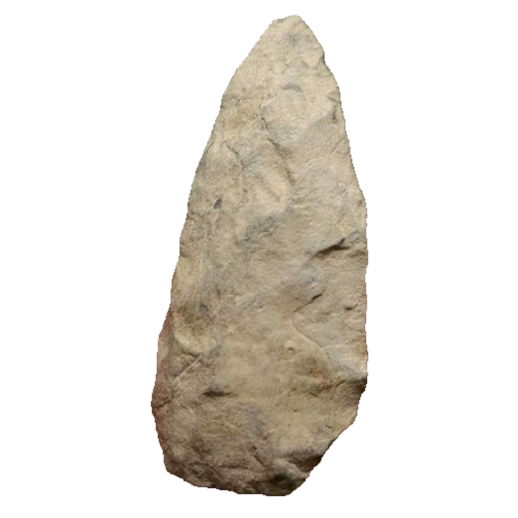
Arrowhead type
Coburn Point
CoburnSusquehanna Cluster3,7000 - 2,700 B.P.Woodland5 reference photos
Key facts
- Age
- 3,7000 - 2,700 B.P.
- Cultural period
- Woodland
- Size
- Medium to Large
- Shape
- Ovoid to Lanceolate
- Glacial period
- Neoglacial
More from the Woodland period
Description
This lanceolate point exhibits a size range of medium to large, characterized by an elliptical cross-sectional profile. The blade's curvature is notably excurvate, with a pronounced inward curve towards the tip, transitioning into a nearly parallel alignment, and then curving inward once more as it approaches the base. Shoulders, when present, are subtly defined, lacking pronounced delineation. The stem's morphology varies from slightly tapering to straight, while the base remains unwaveringly straight. The flaking pattern observed on this point is random, lacking a discernible, organized arrangement.
Size
The dimensions of these arrowheads range from 50 to 140 millimeters in length and from 30 to 70 millimeters in blade width.
Distribution
This type is mainly discovered in Massachusetts and extends into Maine and northeastern New York
Additional information
In the realm of Native American arrowhead typology, the Dudley and Coburn variants are closely associated with the Wayland type, as noted by Justice in 2002. A key observation made by Justice is that these variants may occupy an intermediate position between the Susquehanna and Orient types, suggesting a potential evolutionary link between these distinct arrowhead styles. This insight highlights the complex and nuanced nature of arrowhead classification, where subtle variations in form and design can provide valuable clues about the cultural and technological exchange networks of ancient Native American communities.
The recognition of Dudley and Coburn as Wayland-type variants underscores the importance of careful typological analysis in understanding the development and dissemination of arrowhead technologies across different regions and cultures. By examining the morphological characteristics and distribution patterns of these variants, researchers can gain a deeper understanding of the historical relationships between various Native American groups and the ways in which they adapted and innovated upon existing technologies. The proposed intermediate status of Dudley and Coburn variants between the Susquehanna and Orient types, in particular, invites further investigation into the dynamics of cultural exchange and technological diffusion in Eastern North America.
The study of arrowhead typology, as exemplified by Justice's work, demonstrates the value of meticulous archaeological research in reconstructing the lives and traditions of Native American communities. By combining rigorous classification and analysis with a nuanced understanding of cultural context, scholars can uncover new insights into the complexities of Native American history and the significance of arrowheads as artifacts of technological, social, and symbolic importance. As such, the examination of Dudley and Coburn variants as intermediates between the Susquehanna and Orient types offers a compelling case study in the ongoing quest to understand the rich and diverse heritage of Native American cultures.
Identified by
- Named by
- Dena Dincauze
- Year
- 1968
Similar types
Types that are easy to confuse with the Coburn point.
- Dry Brook
- Frost Island
Other types in the Susquehanna Cluster
- Dudley
- Mansion Inn
- Susquehanna
- Watertown
- Wayland