
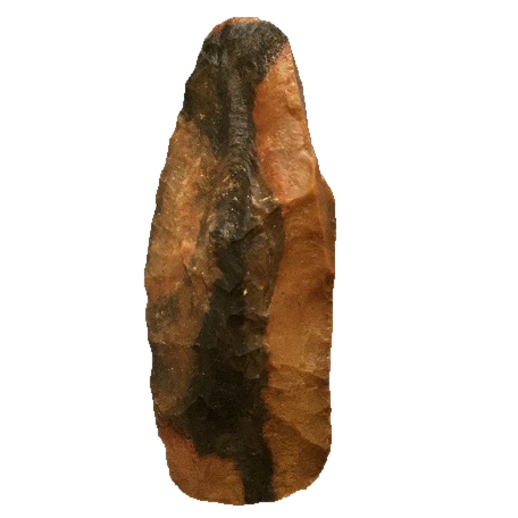
Arrowhead type
Clear Fork Gouge Point
Clear Fork GougeArchaic13 reference photos
Key facts
- Cultural period
- Archaic
- Size
- Medium to Large
- Shape
- Triangle to Ovoid to Lanceolate
- Glacial period
- Culture:
More from the Archaic period
Description
This triangular to sub-triangular gouge exhibits a robust profile, measuring between 1.6 and 3.5 inches in length. The blade's curvature can range from straight to distinctly excurvate. Notably, one edge features a pronounced, gouge-like cutting edge, while the opposing edge may display evidence of either percussion or pressure flaking. The flaking pattern on this tool is typically bi-facial, although some specimens may exhibit unifacial flaking. The base of the gouge can vary in form, and the overall flaking pattern appears to be random, lacking a consistent or deliberate arrangement.
Size
The dimensions of the arrowheads range from 37 to 110 millimeters in overall length and from 30 to 45 millimeters in width.
Distribution
This type is mainly discovered in grassland areas of Texas and extending into Oklahoma
Additional information
The functional significance of this enigmatic tool remains somewhat obscure, with its intended purpose still a subject of debate among archaeologists. Nonetheless, a close examination of the tool's morphology and wear patterns has yielded valuable insights into its possible usage. Specifically, the distinctive wear pattern observed on the surface adjacent to the gouge cutting area suggests that this tool was employed in a pushing or pulling motion, likely in conjunction with a wooden plane. This inference is derived from the characteristic scratches and striations evident on the tool's surface, which imply a repetitive, unidirectional motion.
Further analysis of the tool's size variability has led researchers to propose an intriguing hypothesis regarding the potential mounting of smaller specimens on a handle. This speculation is grounded in the observation that the smaller examples exhibit similar morphological characteristics to their larger counterparts, yet are scaled down in size. It is conceivable that these miniature tools were intentionally designed to be affixed to a handle, thereby facilitating their use in more precise or delicate woodworking applications. While the exact nature of this tool's function remains uncertain, the cumulative evidence from its wear patterns and size distribution provides a compelling narrative about its possible role in the woodworking practices of its creators.
The study of this tool offers a fascinating glimpse into the technological and craft traditions of its associated culture. By carefully considering the tool's design, materials, and wear patterns, researchers can reconstruct the ways in which it was used and valued by its makers. As our understanding of this tool and its context continues to evolve, it is likely that new insights will emerge, shedding further light on the lives and practices of the people who created and utilized this enigmatic artifact.
Identified by
- Named by
- Cyrus Ray
- Year
- 1941
Similar types
Types that are easy to confuse with the Clear Fork Gouge point.
- Covington
- Darl Blade
- Friday
- Gahagan
- Kinney
- Mineral Springs
- Sabine
- San Gabriel