
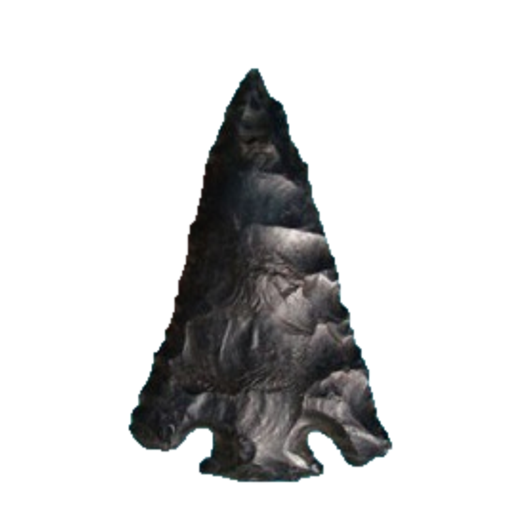
Arrowhead type
Clay Squared Barb Point
Clay Squared Barb4,000 - 3,000 B.P.Late Archaic13 reference photos
Key facts
- Age
- 4,000 - 3,000 B.P.
- Cultural period
- Late Archaic
- Size
- Medium to Large
- Shape
- Basal Notch to Corner Notch
- Glacial period
- Neoglacial
More from the Archaic period
Description
This triangular point exhibits a basal notch configuration, characterized by a medium to large size range of 1.5 to 4 inches. Its cross-sectional profile transitions from an elliptical shape near the apex to a more flattened form towards the base. The blade edge displays a variable curvature, ranging from excurvate to recurvate, with a distinctive inward curve at the tip and an outward flare at the shoulders. The shoulders are adorned with barbed terminations, which can be either angular or squared, although asymmetrical specimens may feature a combination of one squared and one rounded termination. The stem morphology is typically expanding, but can also approach a straight configuration. The base of the point can be slightly convex or concave, and often displays evidence of basal thinning. The flaking pattern on this point is random, lacking a consistent or organized arrangement. Notably, approximately 40% of these points exhibit asymmetry, as observed by Bullen in 1975.
Size
The arrowheads exhibit a range of dimensions, with total lengths spanning 35 to 110 mm, and averaging between 53 to 63 mm. The stem length varies from 6 to 14 mm. In terms of blade dimensions, the width ranges from 25 to 50 mm, with an average width of 33 to 38 mm. The neck width measures between 8 to 23 mm, averaging 13 to 16 mm. The stem width ranges from 10 to 28 mm, with an average of 15 to 23 mm. The thickness of the arrowheads is between 5 to 9 mm.
Distribution
This type is mainly located from mid Florida and extending into Southern Georgia and the southeastern region of Alabama
Also found, less often, in
Additional information
In the realm of Native American arrowhead studies, the Clay point has been posited as a potential variant of the LaFayette point, with the primary distinction lying in the barb terminations. Notably, Clay points exhibit angular or squared barb endings, whereas LaFayette points display more rounded or pointed terminations, as observed by Granger and Granger in their 2013 research. This similarity in form has led some scholars, such as Farr in 2006, to categorize both types under a single designation, referred to as Clay/Lafayette points.
A more nuanced understanding of Clay points emerges from the observations of George Price, as noted by Whately in 2002. Price's examination of Clay points from Turner County, Georgia, revealed several intriguing characteristics. Specifically, these points consistently lacked patination, suggesting a possible correlation with their manufacturing process or environmental context. Furthermore, approximately 75% of the points analyzed by Price were crafted using curved flakes, which were shaped through a relatively careless pressure flaking technique. This distinctive manufacturing approach may provide insight into the technological and cultural practices of the point's creators.
The association of Clay points with ceramics has been a subject of debate among scholars. While George Price's observations suggest that these points are not typically found in conjunction with ceramics, Farr's 2006 research proposes a link between Clay/Lafayette points and Orange Period ceramics. This discrepancy highlights the complexity of interpreting archaeological data and the need for continued research to clarify the cultural and chronological contexts of these enigmatic artifacts. By examining the formal characteristics, manufacturing techniques, and contextual associations of Clay points, researchers can gain a deeper understanding of the lives and traditions of the Native American communities that created these artifacts.
Identified by
- Named by
- Ripley P. Bullen
- Year
- 1968
Similar types
Types that are easy to confuse with the Clay Squared Barb point.