
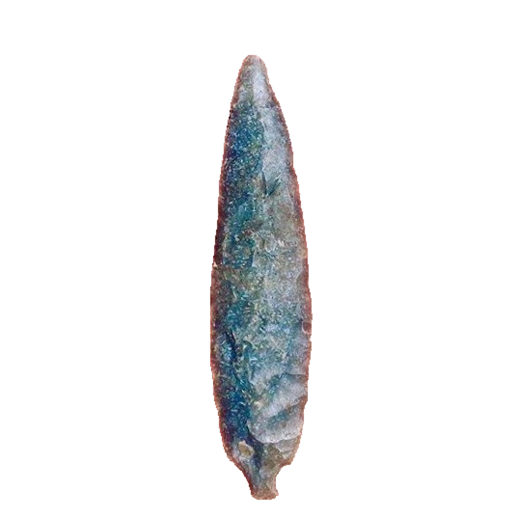
Arrowhead type
Cibolo Knife
Cibolo Knife7,500 - 3,500 B.P.Archaic3 reference photos
Key facts
- Age
- 7,500 - 3,500 B.P.
- Cultural period
- Archaic
- Size
- Large
- Shape
- Straight Stem
- Material
- Chert
- Glacial period
- Early Holocene to Neoglacial
More from the Archaic period
Description
This stemmed lanceolate knife exhibits a distinctive morphology, characterized by an elliptical cross-sectional profile and a medium to large size. The blade's curvature is pronounced, with an excurvate shape that bulges outward from the tip, reaching its maximum width at the midsection, before tapering inward towards the shoulders. The shoulders themselves are subtly defined, displaying a range of orientations from horizontal to slightly elevated. The stem is relatively short, with a variability in width, sometimes expanding and occasionally contracting, terminating in a straight base. The flaking pattern on this artifact is random, resulting from a combination of percussion flaking and secondary pressure flaking techniques, particularly evident around the blade and hafting areas. Overall, the craftsmanship of this knife is noteworthy, reflecting a high level of manufacturing skill.
Size
The dimensions of the arrowheads are as follows: they range in overall length from 110 to 180 mm, with stem lengths varying between 7 and 11 mm. The width of the blade spans from 28 to 35 mm, while the basal width measures between 8 and 15 mm, based on a limited dataset.
Distribution
This type is mainly discovered in the San Antonio area of central Texas, encompassing the counties of Bastrop, Bell, Coryell, Travis, Williamson, Wilson, and the adjacent territories.
Mainly found in
Additional information
More information needed.
Identified by
- Named by
- Sam Williams
- Year
- 2008
- Type site
- Cibolo Creek Sandpit site, Wilson County, Texas
Similar types
Types that are easy to confuse with the Cibolo Knife point.
- Lufkin