
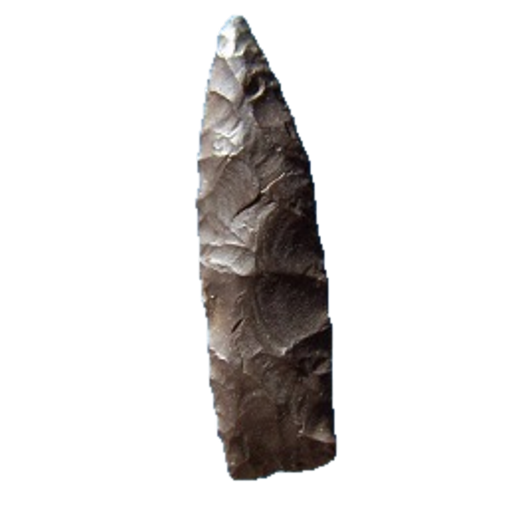
Arrowhead type
Choris Point
Choris3,800 - 2,200 B.P.Transitional Paleo3 reference photos
Key facts
- Age
- 3,800 - 2,200 B.P.
- Cultural period
- Transitional Paleo
- Culture
- Choris Culture
- Size
- Medium to Large
- Shape
- Triangle to Lanceolate
- Material
- Flint
- Glacial period
- Neoglacial
More from the Paleo period
Description
This lithic specimen exhibits a distinctive medium-sized lanceolate to pentagonal morphology, characterized by a cross-sectional profile that transitions from flattened to thin and elliptical. The blade's curvature is notable, as it tapers inward at the tip before becoming parallel and then recurving toward the base. The basal edge displays variability, ranging from straight to subtly concave, with basal corners that are consistently rounded. The flaking pattern observed on this point is characterized by a random, parallel arrangement of flakes, indicative of a deliberate and controlled reduction strategy.
Size
Medium to Large
Distribution
This projectile is located on the Choris Peninsula of Alaska and extends into adjacent areas linked to the Choris and subsequent Norton traditions.
Additional information
The origins of this archaeological tradition can be traced back to the Denbigh Flint Complex, a cultural phenomenon that laid the groundwork for subsequent developments. As noted by Sturtevant in 1978, this complex served as a precursor to the evolution of a distinct cultural identity. Furthermore, research by Bacon in 1975 suggests that this tradition ultimately gave rise to the Norton culture, marking a significant milestone in the cultural trajectory of the region. This sequence of cultural development highlights the dynamic and adaptive nature of the societies that flourished in this area, with each phase building upon the foundations established by its predecessors.
The transition from the Denbigh Flint Complex to the Norton culture is a testament to the complex and nuanced processes that shaped the cultural landscape of the region. By examining the archaeological record, researchers can gain valuable insights into the social, economic, and technological factors that contributed to this cultural evolution. The fact that the Denbigh Flint Complex is thought to have emerged as a distinct entity, only to eventually give way to the Norton culture, underscores the importance of considering the long-term perspectives and continuity of cultural traditions in this region.
The scholarly contributions of Sturtevant and Bacon have been instrumental in illuminating our understanding of this cultural sequence, providing a framework for interpreting the archaeological evidence and reconstructing the history of the region. Their research has helped to establish a chronology of cultural development, highlighting the significance of the Denbigh Flint Complex as a formative period in the evolution of the Norton culture. By building upon this foundation, archaeologists can continue to refine our understanding of the complex cultural dynamics that have shaped the region over time.
Identified by
- Named by
- James L. Giddings
- Year
- 1957
- Type site
- Choris Site, Choris Peninsula, Alaska
Similar types
Types that are easy to confuse with the Choris point.
- Cape Smyth
- Chignik Lanceolate