
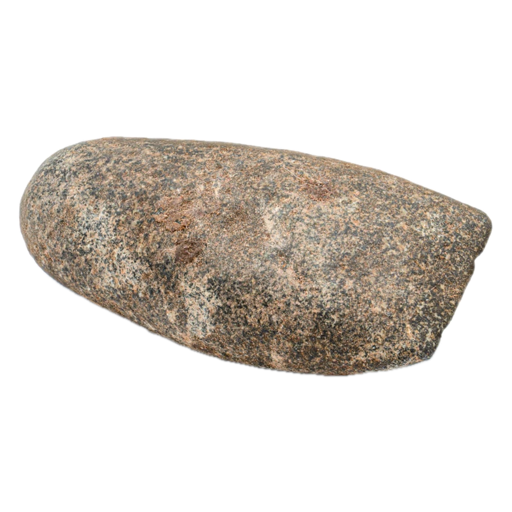
Stone tool type
Celt
Celt6,000 - 500 B.P.Archaic, Woodland, and Mississippian cultures. Highly associated with Adena and Hopewell ceremonial contexts and with Mississippian agricultural societies.3 reference photos
Key facts
- Age
- 6,000 - 500 B.P.
- Cultural period
- Archaic, Woodland, and Mississippian cultures. Highly associated with Adena and Hopewell ceremonial contexts and with Mississippian agricultural societies.
- Size
- Small to Medium to Large
- Shape
- Ungrooved, wedge-shaped ground-stone axe or adze.
- Glacial period
- Late Holocene
More from the Archaic, Woodland, Mississippian periods
Description
A celt is a ground-stone axe or adze that lacks any groove for hafting. Instead, it has a smooth, elongated, wedge-shaped body that was inserted into a socketed wooden handle. Celts are typically highly polished, symmetrically shaped, and tapered toward a beveled cutting edge. They were used for woodworking, shaping logs, carving canoes, and other heavy tasks. Some celts were utilitarian while others were finely made for ceremonial presentations or burials. Materials include greenstone, diorite, basalt, slate, quartzite, and other durable stones.
Size
Typical lengths range from 8 to 30 cm (3 to 12 inches), with some large ceremonial forms reaching 35 to 40 cm (14 to 16 inches). Width often ranges from 3 to 8 cm (1.25 to 3 inches). Thickness commonly ranges from 1.5 to 4 cm (0.5 to 1.5 inches). Celts have a smooth, tapered, elongated body with a rounded or slightly flared poll end. The bit is ground into a beveled and polished cutting edge. The sides are usually straight or slightly convex. Cross-sections are commonly oval, lenticular, or rectangular. Many examples show heavy polish from woodworking, indicating extensive use.
Distribution
Celts are found across nearly all of North America, with the greatest concentrations in the Eastern Woodlands, Ohio Valley, Mississippi Valley, Southeast, and Great Lakes regions. They are also present across the Central Plains, eastern Texas, and into parts of the Northeast and Mid-Atlantic. Their widespread distribution reflects both utilitarian and ceremonial uses. Many of the finest celts come from the Ohio Hopewell, Adena, and Mississippian cultural areas, where they appear in villages, earthwork complexes, burial mounds, and agricultural settlements.
Additional information
Celts are considered one of the most important woodworking tools of prehistoric North America. Their smooth, ungrooved form allowed for secure socketed hafting, typically using wedge-shaped handles. Many utilitarian celts show extreme edge wear, scars, and resharpening, indicating long-term use. Finely polished greenstone celts are prominent grave goods in Adena, Hopewell, and Mississippian burials, sometimes symbolizing leadership, status, or ritual authority. The form persisted for thousands of years with little change because it was highly effective for chopping, planing, and carving wood, especially in regions where constructed architecture was common.