
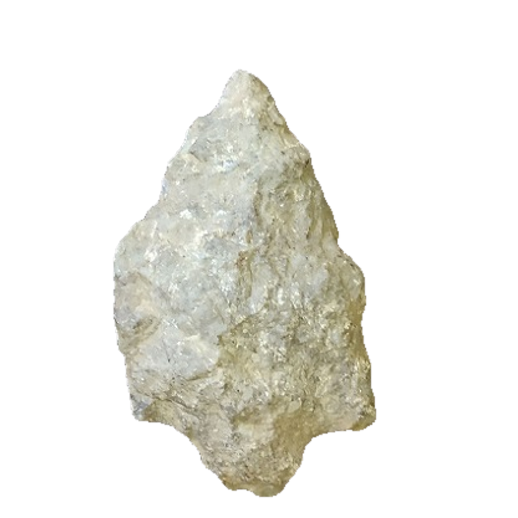
Arrowhead type
Cattle Run Point
Cattle Run5,000 - 3,000 B.P.Late Archaic5 reference photos
Key facts
- Age
- 5,000 - 3,000 B.P.
- Cultural period
- Late Archaic
- Size
- Medium to Large
- Shape
- Contracting Stem
- Glacial period
- Middle Holocene to Neoglacial
More from the Archaic period
Description
This triangular stemmed point exhibits a size range from medium to large, characterized by a cross-sectional shape that transitions from flattened to elliptical. The blade's profile is predominantly excurvate, although it may exhibit a curved tip and parallel edges that extend along approximately half of its length. The shoulders of the point display variability, ranging from a horizontal orientation to a subtle upward incline. The stem tapers slightly, while the base presents a convex curvature. A notable feature of this point is the frequent presence of basal thinning, whereas basal grinding is relatively rare and often limited to light applications when it does occur. The flaking pattern observed on this point is random, lacking a discernible order or arrangement.
Size
Medium to Large
Distribution
This specimen was identified in Virginia and extending into North Carolina and Maryland. It is a variation of the Savannah River type, suggesting a similar geographic range as the Savannah River variant.
Mainly found in
Also found, less often, in
Additional information
The evolution of Native American arrowheads is a complex and fascinating topic, with various researchers contributing to our understanding of these ancient artifacts. Notably, Richie's 1971 study proposed a connection between the Snook Kill point, also associated with the Koens-Crispin and Lehigh cultures, and the Savannah River point. This potential relationship highlights the dynamic exchange of ideas and technologies between different cultural groups. Furthermore, Funk's 1993 research suggested that the Snook Kill point may have played a pivotal role in the development of broad spear type points, which later became prevalent in the Northeast and Mid-Atlantic regions.
The significance of the Snook Kill point lies in its possible status as a transitional type, bridging the gap between earlier and later point styles. This hypothesis is supported by the point's characteristics, which may have influenced the design of subsequent broad spear type points. The Snook Kill point's morphology, therefore, offers valuable insights into the technological and cultural advancements of Native American communities during this period. By examining the Snook Kill point within the context of regional point styles, researchers can gain a deeper understanding of the complex interactions and innovations that shaped the archaeological record.
The Snook Kill point's potential role as a transitional type underscores the importance of continued research into the evolution of Native American arrowheads. As archaeologists, a nuanced understanding of these artifacts is crucial for reconstructing the cultural, social, and technological dynamics of past societies. By building upon the foundations laid by researchers like Richie and Funk, we can refine our knowledge of the Snook Kill point and its place within the broader narrative of Native American archaeological history, ultimately enhancing our appreciation for the ingenuity and craftsmanship of these ancient cultures.
Identified by
- Named by
- Clarence Greier
- Year
- 1996
Similar types
Types that are easy to confuse with the Cattle Run point.
- Koens Crispin
- Morrow Mountain
- Snook Kill