
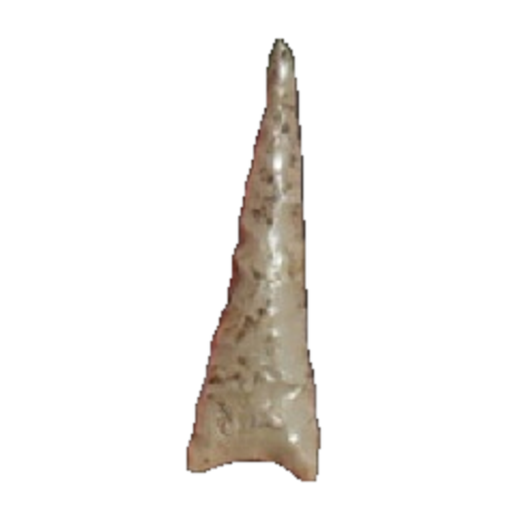
Arrowhead type
Canalino Triangle Point
Canalino TriangleWestern Triangle Cluster700 - 500 B.P.Classic to Historic9 reference photos
Key facts
- Age
- 700 - 500 B.P.
- Cultural period
- Classic to Historic
- Culture
- Canalino Culture
- Size
- Small
- Shape
- Triangle to Lanceolate
- Glacial period
- Medieval Warm to Little Ice Age
More from the Preclassic and Classic, Historic periods
Description
This lithic specimen exhibits a slender, triangular morphology with a flattened profile, characterized by a predominantly straight blade that may occasionally exhibit subtle deviations towards either an excurvate or incurvate trajectory. Notably, numerous examples display serrated edges along the blade's length. The basal margin is typically marked by a pronounced concavity, although some variants may present a more subdued concave curvature. In cases where the blade assumes a slightly incurvate posture and the base is deeply concave, the presence of downward-pointing basal ears is observed. The flaking pattern on this point is randomized, lacking a discernible order or orientation.
Size
The dimensions of the arrowheads are as follows: they range in total length from 21 to 58 mm, with a basal width spanning 11 to 21 mm. Additionally, the basal concavity measures between 1 to 3 mm, and the overall thickness varies from 3 to 5 mm.
Distribution
This type is mainly discovered in the coastal areas of southern California and can also be located in the western parts of the Mojave Desert region.
Mainly found in
Additional information
In the realm of Native American archaeology, a specific type of arrowhead has undergone a notable evolution in nomenclature. Initially, these points were identified by Waldo Wedel in 1941 as "Shallow Tailed" points, a designation that stemmed from their discovery at Buena Vista Lake in Kern County, California. However, this terminology was later modified by Lathrap and Hoover in 1975, who opted to include the associated cultural context in the name, thereby rechristening them "Canalino Shallow Tailed" points. This revised designation not only reflected the points' distinctive morphology but also acknowledged their cultural affinity. Further refinement of the terminology occurred when Justice, in 2002, proposed a shortened version of the name, "Canalino Triangular," which has since been adopted as the standard reference for these artifacts.
The Canalino Triangular points are characterized by their unique combination of traits, which sets them apart from other types of arrowheads. Their shallow tail and triangular shape are distinctive features that have been meticulously documented and analyzed by archaeologists. The points' association with the Canalino culture, as reflected in their name, underscores the importance of considering the broader cultural context in which these artifacts were created and used. By examining the Canalino Triangular points within the framework of their cultural and historical significance, researchers can gain valuable insights into the lives and traditions of the Native American communities that crafted and utilized these tools.
The renaming of the Shallow Tailed points to Canalino Triangular reflects the ongoing refinement of archaeological knowledge and the importance of precise terminology in the field. As our understanding of Native American cultures and their material artifacts continues to evolve, the adoption of more accurate and descriptive names for these artifacts serves to enhance our appreciation of their significance and cultural context. The Canalino Triangular points, with their rich history and distinctive characteristics, remain an important area of study for archaeologists seeking to illuminate the complexities of Native American cultures in California and beyond.
Identified by
- Named by
- Donald W. Lathrap and Robert L. Hoover
- Year
- 1975
- Type site
- Shilimaqshtush site (CA Sba 205), San Luis Obispo County, California
Similar types
Types that are easy to confuse with the Canalino Triangle point.
- Buck Gully
- Cottonwood
- Gunther Triangle
- Price Ranch
Other types in the Western Triangle Cluster
- Bull Creek
- Cohonina
- Canalino
- Malaga Cove Leaf
- Sobaipuri