
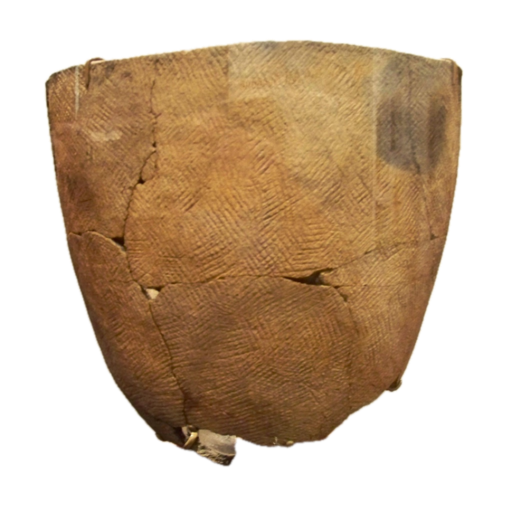
Pottery type
Cahokia Cordmarked Pottery
Cahokia Cordmarked1150 - 1400 A.D.Mississippian Pottery3 reference photos
Key facts
- Age
- 1150 - 1400 A.D.
- Cultural period
- Mississippian Pottery
- Material
- Clay tempered with shell or a mix of shell and grit; exteriors treated with cord-wrapped paddles before firing, producing rough, textured surfaces.
More from the Mississippian period
Description
Cahokia Cordmarked (often called cord-roughened) is a Mississippian utilitarian type marked by cord-impressed surfaces created with cord-wrapped paddles. Vessels are usually jars with globular bodies and everted rims, used primarily for cooking and storage. The cord impressions may be oblique, vertical, or horizontal, and can vary in coarseness, but usually cover most of the exterior surface.
Size
Jars commonly range from about 180 to 320 mm in rim diameter and 200 to 360 mm in height. Wall thickness is generally 6 to 10 mm, with thicker bases and shoulders for durability.
Distribution
Most common in the American Bottom region around Cahokia in southwestern Illinois and eastern Missouri, with related cordmarked Mississippian wares extending up and down the Mississippi River valley.
Additional information
Cahokia Cordmarked appears relatively late in the Cahokia sequence and is associated with the later Stirling and Sand Prairie phases. Cord-roughened surfaces are thought to improve handling and heating characteristics of cooking vessels.