
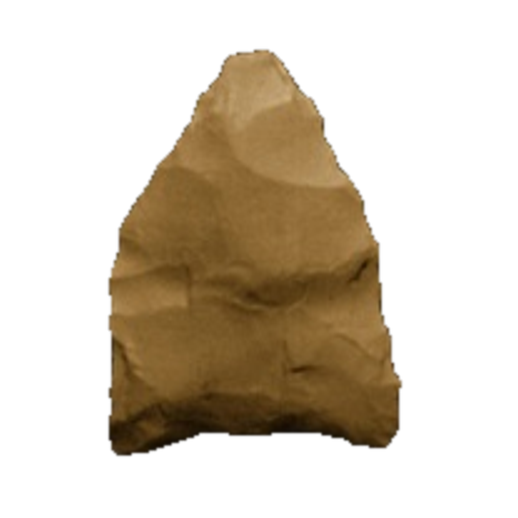
Arrowhead type
Cactus Hill Point
Cactus Hill20,000 - 18,000 B.P.Paleo6 reference photos
Key facts
- Age
- 20,000 - 18,000 B.P.
- Cultural period
- Paleo
- Size
- Medium
- Shape
- Triangle
- Glacial period
- Middle Pleistocene
More from the Paleo period
Description
This triangular point measures between 1.25 and 1.75 inches in length, characterized by a stemmed to expanding stem morphology and a flattened cross-sectional profile. The blade exhibits a predominantly straight edge, culminating in a sharp, well-defined tip. The stem is notably elongated, with a subtle expansion towards the base, which can vary from a straight to a slightly convex configuration. The flaking pattern observed on this point is random, lacking a discernible or consistent pattern.
Size
Medium
Distribution
These artifacts are linked to the Cactus Hill location in eastern Virginia.
Mainly found in
Also found, less often, in
Additional information
The discovery of arrowheads at the Cactus Hill site, particularly those found in layers beneath Clovis points, has sparked intense debate among archaeologists regarding their validity as Pre-Clovis artifacts. To be considered a legitimate Pre-Clovis site, three crucial criteria must be met: evidence of human presence, secure geochronological dating, and an undisturbed stratigraphic context (Perron, 1999). The Cactus Hill site satisfies the first criterion, as the span of human activity at the site is well-documented. Radiocarbon dating of levels below the Clovis layers has yielded dates ranging from 10,500 to 16,500 years before present, thereby fulfilling the second criterion.
However, the site's stratigraphic context poses a significant challenge in meeting the third criterion. Located on a sand dune, the site is prone to post-depositional disturbance, which can compromise the integrity of the stratigraphic record. While the upper levels of the site exhibit no clear signs of stratification, the lower levels feature reddish-brown layers that could be interpreted as evidence of stratification. Researchers such as James Feathers from the University of Washington have investigated this issue and found that the occupation levels appear to be undisturbed and unmixed. This conclusion has been corroborated by Lucinda McWeeney from Yale University and Carol Mandryk from Harvard University. Nevertheless, evidence of limited disturbance to the strata has been detected, potentially caused by the burrowing activities of small rodents. Some scholars have suggested that the apparent stratification at the site may be an artifact of the dune's natural characteristics rather than a result of human occupation.
The interpretation of the Cactus Hill points is further complicated by the Solutrean hypothesis, proposed by Dennis Stanford, which posits that these points represent a midpoint between the French Solutrean and Clovis types. However, with only a single site producing these types of points and a limited number of examples available, the evidence for this hypothesis remains inconclusive. As a result, the debate surrounding the validity and significance of the Cactus Hill points continues, highlighting the complexities and challenges inherent in reconstructing the lives and cultures of ancient human populations. Despite these challenges, the Cactus Hill site remains a crucial component of the ongoing discussion about the peopling of the Americas and the development of Pre-Clovis cultures.
Identified by
- Named by
- Joseph McAvoy and Lynn McAvoy
- Year
- 1997
- Type site
- Cactus Hill (44Sx202)Sussex County, Virginia
Similar types
Types that are easy to confuse with the Cactus Hill point.
- Clovis
- Ely's Ford
- Hardaway Blade
- Miller Lanceolate