
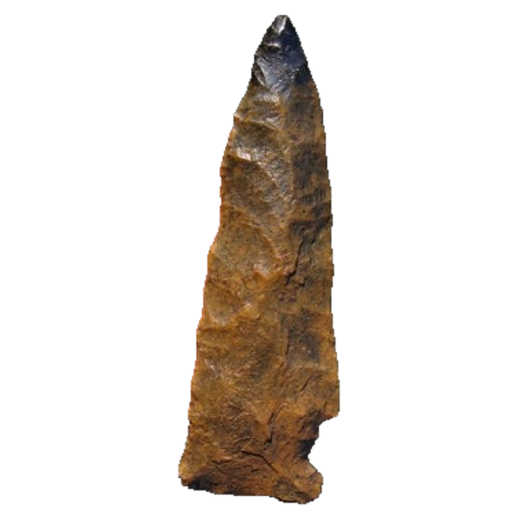
Arrowhead type
Bullen Knife
Bullen Knife1,700 - 1,400 B.P.Woodland3 reference photos
Key facts
- Age
- 1,700 - 1,400 B.P.
- Cultural period
- Woodland
- Culture
- McKeithen Weeden Island Cultures
- Size
- Medium
- Shape
- Side Notch to Corner Notch
- Glacial period
- Roman
More from the Woodland period
Description
This corner notch knife, measuring between 2 to 3 inches in length, exhibits a distinctive cross-sectional profile that can range from an elliptical shape to one featuring a pronounced median ridge. The blade itself is predominantly excurvate, with a single notch extending from the corner to form a barbed shoulder that merges into an expanding stem. The unnotched edge often displays a beveled characteristic, while the base can vary in shape, oscillating between a convex and a slightly concave form. Notable features of this type include basal thinning and subtle grinding in the hafting region, indicative of meticulous preparation for attachment. The overall morphology of this knife is achieved through the application of collateral flaking, with minimal to no evidence of pressure flaking, highlighting the skillful use of flaking techniques to shape this tool.
Size
Medium
Distribution
These artifacts are mainly concentrated within the realm of the McKeithen Weeden Island cultural sphere
Mainly found in
Additional information
In a notable study, Schroder (2011) unearthed previously unreported examples of a specific arrowhead type, initially discovered by Ripley Bullen. Furthermore, an investigation by Wilfred Neil in 1963 yielded an example of this type at the Taylor County site, which Neil classified as a Single Shoulder Knife. This particular type bears a striking resemblance to the Pipe Creek knife, a style that has been found to span a considerable geographic range, from Texas to the Tennessee River Valley. The similarity between these two types suggests that they may be part of a larger distribution network, potentially indicating the movement or exchange of similar technological or cultural ideas across different regions. This phenomenon highlights the complex and dynamic nature of prehistoric cultural interactions, where the dissemination of tool types and technologies played a significant role in shaping the material culture of various Native American groups.
The discovery of this arrowhead type at the Taylor County site, coupled with its resemblance to the Pipe Creek knife, underscores the importance of considering the broader cultural and geographic context in which these artifacts were created and used. By examining the distribution and characteristics of these tools, researchers can gain valuable insights into the social, economic, and technological dynamics of prehistoric societies, ultimately contributing to a more nuanced understanding of Native American cultural diversity and complexity.
The presence of similar arrowhead types across different regions also raises intriguing questions about the mechanisms of cultural exchange and the diffusion of technological innovations in prehistoric North America. As archaeologists continue to investigate the origins, spread, and evolution of these tool types, they may uncover new evidence that sheds light on the intricate networks of interaction and exchange that existed among Native American communities, ultimately enriching our understanding of the rich and varied cultural heritage of these societies.
Identified by
- Named by
- Lloyd Schroder
- Year
- 2002
Similar types
Types that are easy to confuse with the Bullen Knife point.