
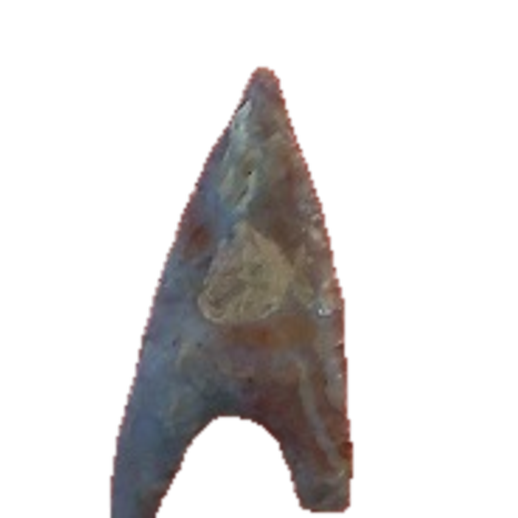
Arrowhead type
Buck Gully Triangle Point
Buck Gully TriangleWestern Triangle Cluster1,400 - 650 B.P.Late Prehistoric to Developmental4 reference photos
Key facts
- Age
- 1,400 - 650 B.P.
- Cultural period
- Late Prehistoric to Developmental
- Size
- Small
- Shape
- Triangle to Lanceolate
- Material
- Pottery
- Glacial period
- Vandal Minimum to Medieval
More from the Late Prehistoric, Developmental periods
Description
This diminutive triangular point, measuring between 1 to 1.25 inches in length, exhibits a distinctive elliptical profile. Its overall form can range from a symmetrical, isosceles triangle, characterized by a height that is roughly twice its width, to variations with more nuanced proportions. The blade's curvature is highly variable, with excurvate forms being most prevalent, although straight-edged and incurvate examples also occur. Notably, the base of the point features a pronounced, concave recess, accentuated by sharp, angular auricles. The flaking pattern observed on this point is random, lacking a discernible, organized arrangement.
Size
The dimensions of the arrowheads are as follows: they range in total length from 21 to 38 mm, with a basal width spanning 10 to 21 mm. Additionally, the basal concavity measures between 3 to 5 mm, and the overall thickness of the arrowheads falls within the same range of 3 to 5 mm.
Distribution
This type is mainly located in the New Port area of southern California (Doty)
Mainly found in
Additional information
In the realm of archaeological literature, the Cottonwood Triangular points are a distinct type of projectile point, characterized by their deeply concave base. Notably, the base of these points can exhibit slight variations, but the concave nature remains a consistent feature. Interestingly, these points share similarities with the Bull Creek points, which are commonly found in the Four Corners region. This similarity highlights the potential for cultural exchange or technological diffusion between these geographic areas.
A related point type, known as the Buck Gully or Auriculated Triangular point, was first identified by John E. Fitch, a California Fish and Game Biologist and avocational archaeologist, and later formalized by archaeologist Lester A. Ross. These small, triangular-shaped projectiles, measuring between 1 and 1.5 inches in length, are relatively crude and exhibit auriculated characteristics. The blades of these points expand from the tip to the base, which is the widest portion of the point. A distinctive feature of the Buck Gully points is the presence of moderately concaved bases with prominent ears at the corners. The distribution of these points is limited to the Newport Beach region in Orange County, California, and they are associated with the late Prehistoric period.
The discovery of Buck Gully points at the Buck Gully #1 (4ORA190) and #2 (4ORA189) archaeology sites in Orange County, California, has provided valuable insights into the technological and cultural practices of the region's indigenous populations during the late Prehistoric period. As noted by Lester A. Ross in his 1970 publication, "A Descriptive Site Report of a Late Prehistoric Horizon Site in Orange County, California" (Pacific Coast Archaeological Society Quarterly, Vol. 6, No. 2/3), these points offer a unique window into the lives of the people who created and used them. By examining the characteristics and distribution of these points, researchers can gain a deeper understanding of the cultural and technological developments that occurred in this region during the late Prehistoric period.
Identified by
- Named by
- Lester A. Ross and John E. Finch
- Year
- 1970
- Type site
- Buck Gully Canyon, Orange County California
Similar types
Types that are easy to confuse with the Buck Gully Triangle point.
- Bull Creek
- Canalino
- Cottonwood Triangle
- Gunther Triangle
- Price Ranch
Other types in the Western Triangle Cluster
- Aguaje
- Cohonina
- Sobaipuri