
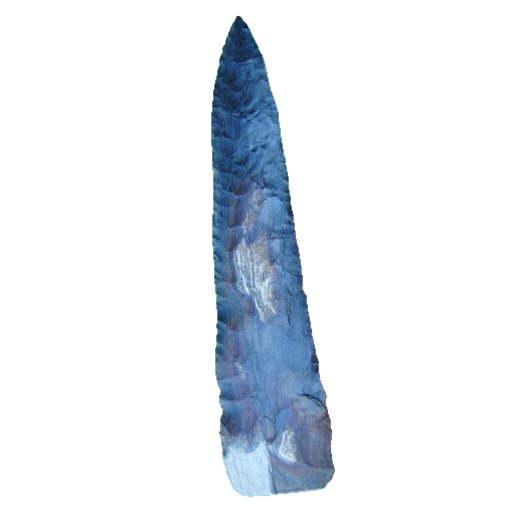
Arrowhead type
Bronson Bi-Face Point
Bronson Bi-Face1,800 - 700 B.P.Middle ArchaicKey facts
- Age
- 1,800 - 700 B.P.
- Cultural period
- Middle Archaic
- Size
- Medium to Large
- Shape
- Triangular to Ovoid
- Glacial period
- Roman to Medieval Warm
More from the Archaic period
Description
This bi-face knife exhibits a medium to large size range and a varied outline, oscillating between triangular and asymmetrical configurations. Its cross-sectional profile is characterized by a flattened shape. The blade's morphology is marked by an excurvate shape, with two distinct forms: a more common, crudely crafted version featuring two parallel edges that converge to a rounded or pointed apex, and a less common, more refined variant that displays a subtle curvature from the tip to the base. Notably, the base of the knife remains unfinished, retaining a weathered cortex that bears testament to its natural origins.
Size
Medium to Large
Distribution
This type is mainly discovered in the eastern part of Texas and extending into western Louisiana, southeastern Oklahoma and southwestern Arkansas
Additional information
More information needed.
Identified by
- Named by
- Edward Jelks
- Year
- 1965
- Type site
- Three Sites at McGee Bend Reservoir, Texas