
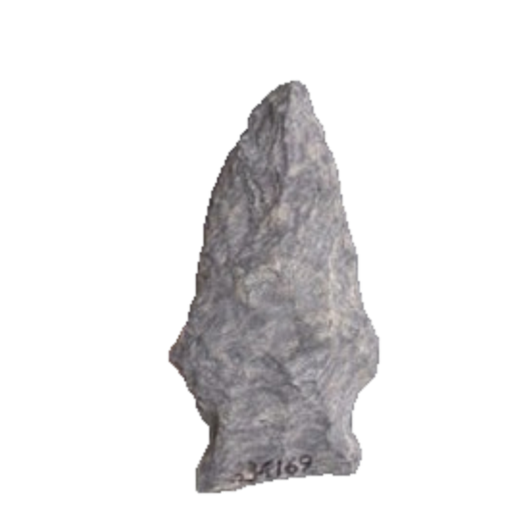
Arrowhead type
Backstrum Point
Backstrum3,000 - 2,000 B.P.Early Archaic3 reference photos
Key facts
- Age
- 3,000 - 2,000 B.P.
- Cultural period
- Early Archaic
- Size
- Small to Medium
- Shape
- Side Notch
- Glacial period
- Neoglacial to Roman Warm
More from the Archaic period
Description
This diminutive projectile point, measuring between 1.5 and 2 inches in length, exhibits a side notch configuration and an elliptical cross-sectional profile. The blade itself is characterized by an excurvate shape, with shoulders that slope upward at a pronounced angle. The stem expands downward, terminating in a base that can range from straight to subtly concave. The flaking pattern observed on this point is random, lacking a discernible or deliberate arrangement.
Size
Small to Medium
Distribution
This type is mainly located in the southwestern region of Pennsylvania, extending into Ohio and West Virginia
Mainly found in
Additional information
In the realm of Native American archaeology, the Backstrum Side Notch arrowhead type holds significant interest, particularly in the context of the Eastern Woodlands. This distinct projectile point was first identified by archaeologist Richard L. George, who named it after discovering examples at the Winters Knuckles archaeological site, located in Westmoreland County, Pennsylvania. Specifically, the site is situated opposite the mouth of Sewickly Creek on the Youghiogeny River, a region that has yielded a wealth of information about the lives and traditions of indigenous peoples.
Characterized by their compact size, typically measuring between 1.50 and 2 inches in length, Backstrum Side Notch arrowheads are distinguished by their elongated side indentations and straight or slightly concave bases. These morphological features bear resemblance to other side-notched point types found in the region, highlighting the shared technological and cultural practices among Native American groups in western Pennsylvania, eastern Ohio, and northwestern West Virginia. The distribution of these arrowheads corresponds to the middle to early Woodland period, a time of significant cultural and technological development in Eastern North America.
Despite their importance, Backstrum Side Notch arrowheads have not received widespread attention, and as a result, the term is primarily used among local collectors and specialists. However, the work of Richard L. George has shed valuable light on this point type, as evident in his publications, including "Early Late Woodland in Pennsylvania: The Backstrum Side Notched Point Evidence" (1992) and "The Winters-Knuckles site and the Mystery House on the Youghiogeny" (1996). These studies have contributed substantially to our understanding of the Backstrum Side Notch arrowhead and its place within the broader context of Native American archaeology in the region.
Identified by
- Named by
- Richard L. George
- Year
- 1996
- Type site
- Backstrum Site, Western Pennsylvania