
Pottery type
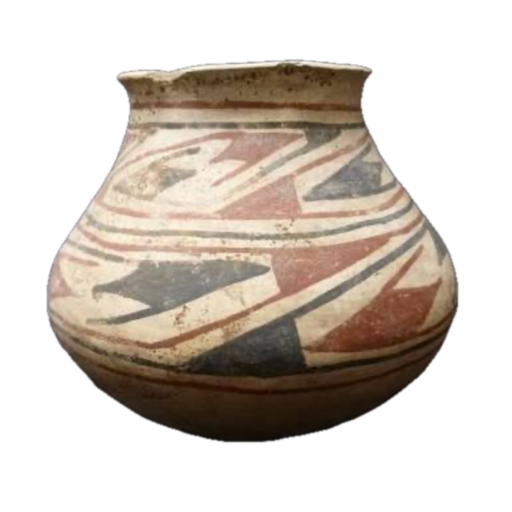
Babicora Polychrome Pottery
Babicora Polychrome1200 - 1450 A.D.Casas Grandes / Paquime Pottery2 reference photos
Key facts
- Age
- 1200 - 1450 A.D.
- Cultural period
- Casas Grandes / Paquime Pottery
- Material
- Well-levigated clay with fine mineral temper; unslipped or lightly slipped tan to brown bodies with red and black mineral paints applied over a carefully smoothed surface.
Description
Babicora Polychrome is a decorated Casas Grandes (Paquimé) pottery type characterized by cream to light brown surfaces with red and black painted designs. Designs often show widely spaced linear elements, scrolls, stepped motifs, and interlocking geometric patterns, sometimes combined with small solid elements to maintain visual balance. It is closely related to Ramos Polychrome and other Medio period types, but typically features broader spacing between painted elements and slightly different layout conventions.
Size
Bowls and jars commonly range from about 150 to 350 mm in diameter and 120 to 300 mm in height, with wall thickness usually around 4 to 8 mm. Effigy and specialized vessels may fall outside these ranges but are less common.
Distribution
Produced in the Casas Grandes region of northwestern Chihuahua, with sherds and vessels distributed widely through trade into southern New Mexico, the Arizona “boot heel,” and parts of west Texas.
Mainly found in
Additional information
Babicora Polychrome is often treated as an early or variant form closely associated with Ramos Polychrome, and sherd-level identification can be subtle. Motif choice, line spacing, and associations with other Medio period materials help refine type assignments.