
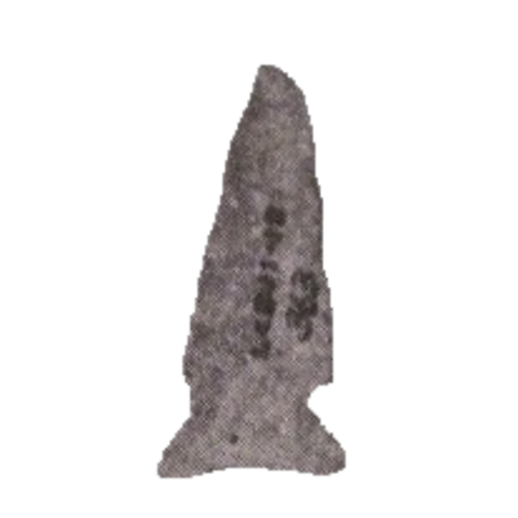
Arrowhead type
Atotonilco Side Notch Point
Atotonilco Side Notch1,800 - 1,400 B.P.Developmental to Late Prehistoric2 reference photos
Key facts
- Age
- 1,800 - 1,400 B.P.
- Cultural period
- Developmental to Late Prehistoric
- Culture
- Loma, Guadiana and Suchil Chalchihuites culture
- Size
- Small to Medium
- Shape
- Side Notch
- Glacial period
- Roman Warm to Vandal Minimum
More from the Late Prehistoric, Developmental periods
Description
This triangular side notch point exhibits a compact to medium size profile, characterized by a slender, oval-shaped cross-section. The blade's longitudinal profile is predominantly straight, with a subtle curvature that occasionally gives way to a gently excurvate shape. The notches are positioned relatively low on the blade, creating a shoulder that forms a horizontal line or, in some cases, assumes a slight, upward inclination. The stem's morphology varies from expanded to tapering, with a basal edge that is either straight or faintly concave. Notably, the basal corners may occasionally display a squared morphology. The flaking pattern observed on this point is random, lacking a discernible, organized arrangement.
Size
The dimensions of the arrowheads are as follows: they range in length from 22 to 57 mm, with a mean length of 37 mm. The width of the blade varies between 12 and 26 mm, averaging 20 mm. In terms of thickness, the measurements span from 3 to 6 mm, with an average thickness of 5 mm.
Distribution
These artifacts are mainly located in the Loma, Guadiana Chalchihuites, and Suchil Chalchihuites archaeological zones of Chihuahua, Durango, Zacatecas, San Luis Potosi, Jalisco, and Aguascalientes Mexico
Mainly found in
Additional information
In comparing the characteristics of certain arrowhead types, it is notable that the Santa Ana Side Notch exhibits distinct differences in its morphology. Specifically, this type tends to be narrower and longer in comparison to other similar styles. A key diagnostic feature of the Santa Ana Side Notch is its straight base, which serves as a distinguishing trait. As observed by Spence in 1971, these characteristics collectively contribute to the unique identification of the Santa Ana Side Notch, setting it apart from other arrowhead types within the same cultural and geographical context.
The straight base of the Santa Ana Side Notch is a particularly noteworthy aspect, as it provides a clear point of differentiation from other arrowhead styles that may exhibit more curved or rounded bases. The narrower and longer proportions of the Santa Ana Side Notch also underscore its unique design and potential functional adaptations. By examining these characteristics in conjunction with one another, researchers can gain a more nuanced understanding of the technological and cultural developments that shaped the production of arrowheads among Native American communities.
The work of Spence in 1971 highlights the importance of meticulous observation and documentation in the field of archaeology, particularly when it comes to the study of small, yet highly informative artifacts like arrowheads. Through continued research and analysis, scholars can continue to refine our understanding of the historical and cultural contexts in which these artifacts were created and used, ultimately shedding further light on the lives and traditions of Native American communities.
Identified by
- Named by
- Michael W. Spence
- Year
- 1971