
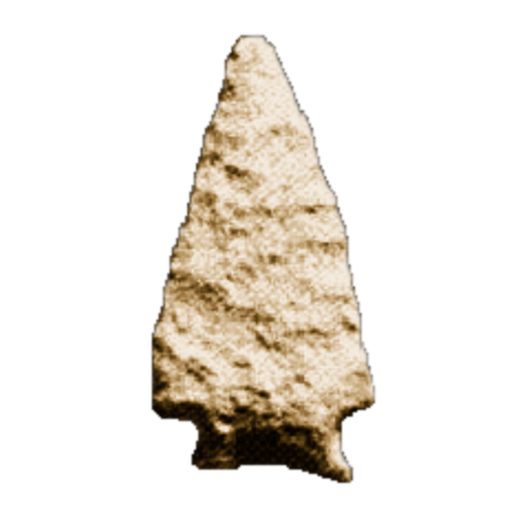
Arrowhead type
Arden Point
Arden7,000 - 6,000 B.P.Woodland3 reference photos
Key facts
- Age
- 7,000 - 6,000 B.P.
- Cultural period
- Woodland
- Size
- Small to Medium
- Shape
- Corner Notch
- Material
- Shell
- Glacial period
- Middle Holocene
More from the Woodland period
Description
This triangular corner notch point measures between 1 1/2 to 2 inches in length, exhibiting a distinctive elliptical profile in cross-section. The blade's curvature can range from straight to excurvate, while the shoulders display subtle barbing, often with one shoulder featuring a rounded contour. The stem expands outward, terminating in a concave base. The flaking pattern on this point is characterized by a random arrangement of flakes, lacking a deliberate or organized sequence.
Size
The dimensions of the arrowheads are as follows: they range in total length from 25 to 55 mm, with stem lengths varying between 5 and 8 mm. The width of the blade spans 18 to 25 mm, while the neck width measures between 15 and 20 mm. The basal width, slightly narrower than the blade, falls within the range of 17 to 22 mm. These measurements are based on a limited dataset.
Distribution
This type is mainly discovered in the southern Hudson Valley region and extends into southeastern Pennsylvania and northeastern New Jersey
Additional information
In the realm of Native American archaeology, the Arden (Corner Notch) projectile point is a notable example of Early Archaic period technology. This specific type of arrowhead was first identified and named by Louis Arthur Brennan, a self-taught archaeologist, after discovering examples at a site near the town of Arden in Orange County, New York. Characterized by their compact size, typically ranging from 1 ½ to 2 inches in length, these projectiles often feature fine serrations and distinctive barbed shoulders. The stems of these points are expanded, with concave bases, and frequently exhibit asymmetrical barbs, where one may be more pronounced than the other.
The distribution of Arden points is largely confined to New York, highlighting the regional specificity of this technological tradition. Their use during the Early Archaic period, which spans from approximately 8,000 to 6,000 years ago, underscores the significance of these points in the context of Native American cultural and technological development. As documented by Brennan in his 1974 publication, "The Lower Hudson: A Decade of Shell Middens" (Archaeology of Eastern North America, Vol. 2, No. 1, pp. 81-93), the Arden point represents an important component of the region's archaeological record.
Notable for their intricate design and craftsmanship, Arden points demonstrate the resourcefulness and adaptability of Native American communities during the Early Archaic period. The presence of these points in the archaeological record provides valuable insights into the lives and traditions of the people who created and used them, offering a unique window into the cultural and technological practices of the region's indigenous populations. As such, the study of Arden points contributes significantly to our understanding of the complex and dynamic history of Native American cultures in the Northeast.
Identified by
- Named by
- Louis A. Brennan
- Year
- 1974
- Type site
- Arden, Orange County, New York and several sites at the mouth of the Croton River.
Similar types
Types that are easy to confuse with the Arden point.
- Wells Bridge Corner Notch